
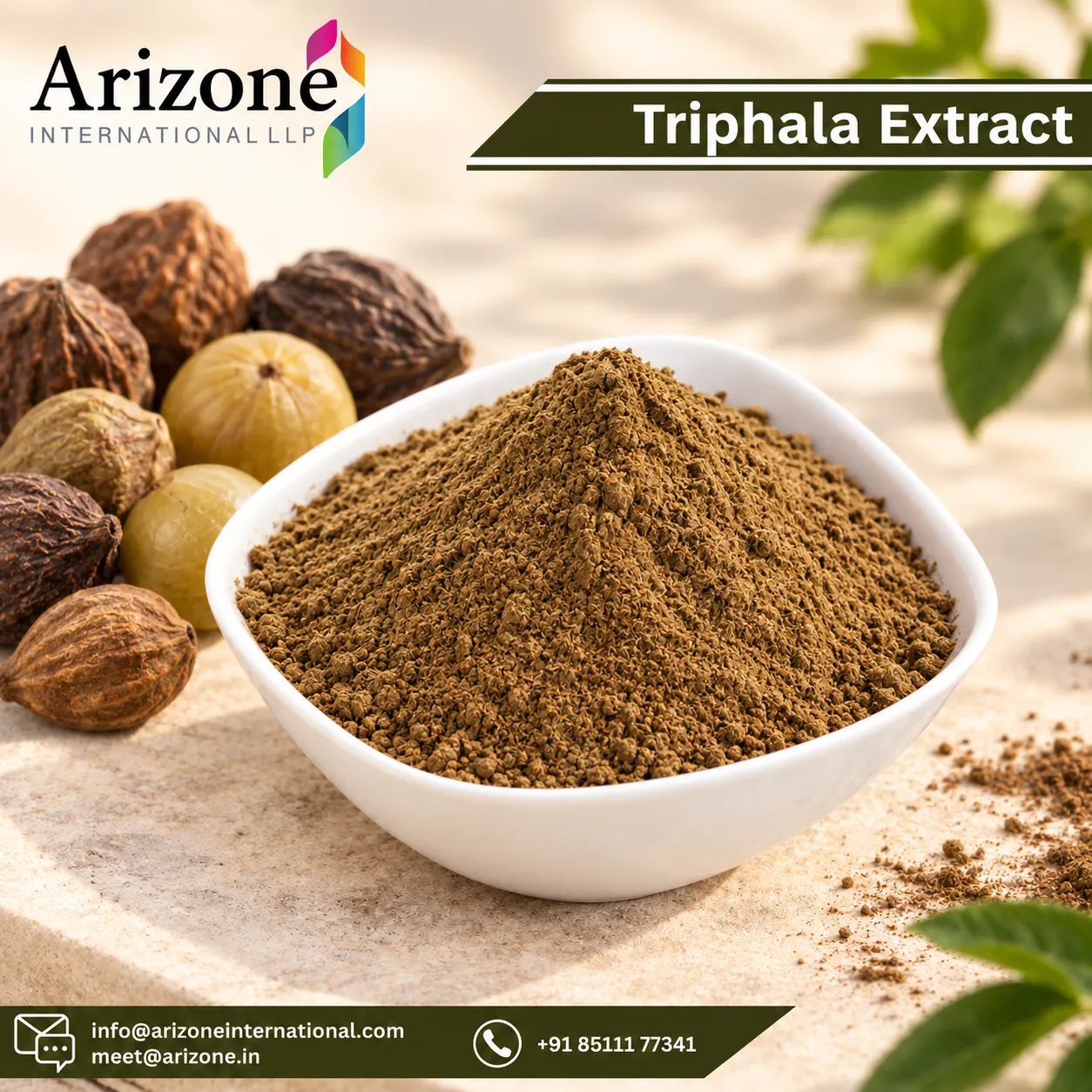
Triphala is the most famous Ayurvedic blend outside India, sold as powder and capsules in the US, UK, Germany and Australia. For an importer, the biggest risk is not the herb itself but contamination: Ayurvedic products have had a reputation problem with heavy metals since a widely reported 2008 US study.
In short: buy triphala with per-batch heavy metal results by ICP-MS that meet your strictest market (often California Prop 65 for the US), a tannin or gallic acid assay, and proof that each of the three fruits was identified and tested before blending.
Key takeaways
- Triphala is equal parts of three dried fruits: amla, haritaki and bibhitaki.
- Its main compounds are tannins and related acids: gallic acid, chebulinic acid, chebulagic acid and ellagic acid.
- Some commercial triphala powders have tested above lead limits; test every batch.
- The EU lead limit for food supplements is 3.0 mg/kg; Prop 65 works on daily exposure and is far stricter.
What triphala is
| Fruit | Latin name | Notes |
|---|---|---|
| Amla (amalaki) | Phyllanthus emblica | Rich in tannins; see our amla guide |
| Haritaki (harad) | Terminalia chebula | Source of chebulinic and chebulagic acids |
| Bibhitaki (baheda) | Terminalia bellirica | Gallic and ellagic acid |
The fruits are de-seeded, dried, powdered and mixed, usually in equal parts. Triphala extract is made by extracting the blend (or each fruit) with water or water-alcohol and drying it to a powder standardised to tannins or gallic acid.
Heavy metals: the main risk
In 2008, a study in the Journal of the American Medical Association found that about one in five Ayurvedic products bought online in the US contained detectable lead, mercury or arsenic. Most of the worst results came from traditional mineral preparations (rasa shastra), not plain herb powders, but the finding shaped how regulators and retailers see the category. More recently, an X-ray fluorescence study of five commercial triphala churna samples found lead well above the permitted daily exposure limit.
Plain herb powders take up metals from soil, dust during sun-drying and worn grinding equipment. The fix is testing and process control:
- ICP-MS for lead, cadmium, arsenic and mercury on every batch, by an accredited lab.
- Raw fruit tested before blending, so one bad lot doesn't contaminate a whole batch.
- Clean drying (not on open ground) and stainless steel milling.
Our article on lead testing in turmeric explains limits and lab methods in more detail.
Selling triphala in the US or EU? Ask us for ICP-MS heavy metal results with your quote.
Request SpecsTannins and markers
- Total tannins (often 20–40% in extracts) by a pharmacopoeial method.
- Gallic acid by HPLC, a common, specific marker.
- Chebulinic and chebulagic acid by HPLC if you need to confirm haritaki content.
- Moisture and flow: triphala powder is hygroscopic and flows poorly, which matters for capsule filling.
Checking the blend
It's hard to prove a 1:1:1 ratio from the finished powder. Good practice is to identify each fruit separately (macroscopy and HPTLC), keep weighing records for the blend, and run an HPTLC fingerprint of the final powder that shows the marker bands of all three fruits. Ask for this as part of the batch record, not just the COA.
Rules by market
- USA: dietary supplement under FDA GMP (21 CFR 111). In California, Proposition 65 requires a warning if a daily serving exposes the consumer to more than 0.5 micrograms of lead, which is much stricter than a concentration limit.
- EU: the contaminants regulation (EU) 2023/915 sets maximum levels for food supplements: lead 3.0 mg/kg, cadmium 1.0 mg/kg and mercury 0.10 mg/kg. No health claims are authorised for triphala.
- UK: similar limits; medicinal claims need a traditional herbal registration.
- Australia: listed medicine rules with heavy metal requirements.
Buyer checklist
- Three fruits named with Latin names and the blend ratio
- ICP-MS heavy metals per batch, meeting your strictest market
- Tannins and gallic acid with method
- HPTLC fingerprint of the blend
- Pesticides, aflatoxins and microbiology
- Prop 65 serving calculation for US products
With triphala, the herbs are rarely the problem. Untested lead is.
Triphala and Its Three Fruits
Triphala extract, powder and capsules plus amla, haritaki and bibhitaki for supplement brands, with a COA for every batch.

Triphala from Arizone
Arizone International LLP supplies triphala extract and powder, and makes triphala capsules for brands outside India. Tell us your markers, heavy metal limits and market, and we'll confirm the specification and testing.
Sources: JAMA (2008): lead, mercury and arsenic in Ayurvedic medicines sold online; Pharmacognosy Journal: elemental analysis of triphala churna; EU Regulation 2023/915 on contaminants; California OEHHA: Proposition 65.
Triphala Questions
Amla (Phyllanthus emblica), haritaki (Terminalia chebula) and bibhitaki (Terminalia bellirica), usually in equal parts.
It shouldn't, but some commercial samples have tested high. Buy only with per-batch ICP-MS heavy metal results.
3.0 mg/kg under Regulation (EU) 2023/915, with separate limits for cadmium and mercury.
Products sold in California need a warning if a daily serving gives more than 0.5 micrograms of lead.
Usually to total tannins or to gallic acid by HPLC, sometimes with chebulinic acid as an extra marker.