
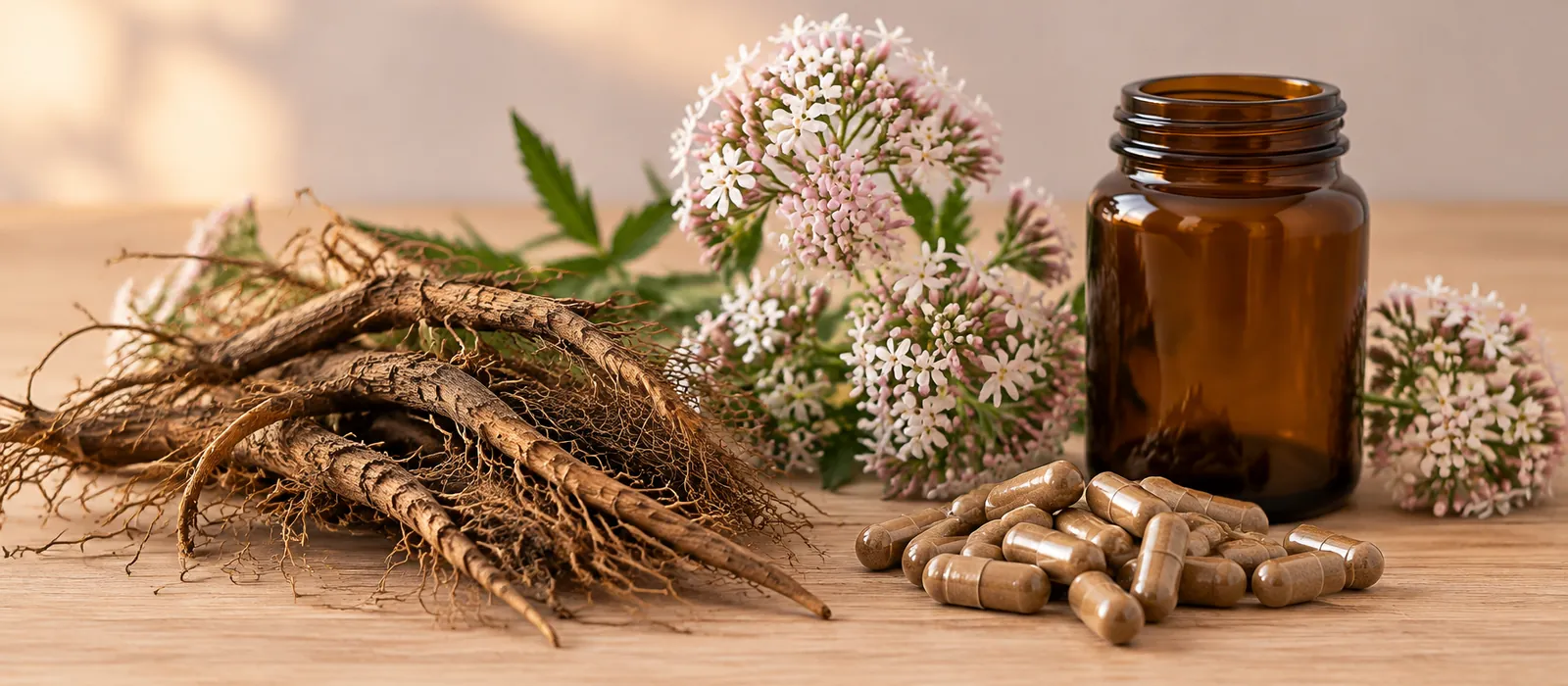
Image: Freepik
Valerian root capsules are among the best-known herbal products for evening and relaxation ranges in Europe, the UK and the US. Valerian is also unusual: in much of Europe it is sold as a registered traditional herbal medicine, while in the US it is a dietary supplement. That split shapes how capsules are formulated, labelled and sold in each market.
In short: valerian capsules contain root powder or root extract of Valeriana officinalis, often specified by valerenic acids. In the EU and UK, products with medicinal wording need a herbal medicine registration based on the EU monograph; in the US they are supplements with structure and function wording.
Key takeaways
- Valerian capsules use the root of Valeriana officinalis, as powder or as a dry extract made with water or ethanol.
- Valerenic acids are the usual marker for quality; the strong smell comes from isovaleric acid.
- The EU herbal monograph (HMPC, 2016) sets out accepted extract types and uses; national authorities grant registrations.
- Valerian can add to the effect of alcohol and sedative medicines, so labels need clear warnings.
What valerian root capsules contain
Valerian (Valeriana officinalis) is a tall perennial with pale pink flowers, but only the root and rhizome are used. Capsules contain either dried root powder or a dry extract, usually made with water or an ethanol-water mixture. Extracts concentrate the root and give a more consistent product than powder.
| Form | What it is | Notes |
|---|---|---|
| Root powder | Dried, milled root | Traditional; strong smell |
| Aqueous dry extract | Water extract, dried | Recognised in the EU monograph |
| Ethanolic dry extract | Ethanol-water extract, dried | Often standardised to valerenic acids |
Valerenic acid and quality
Valerenic acids are characteristic compounds of valerian and are the usual marker for standardised extracts, measured by HPLC. Valerian also contains valepotriates and essential oil compounds that break down with heat and time, which is why drying and storage matter. The famous smell comes mainly from isovaleric acid, so good packaging and odour-control are part of a quality product.
- Identity of Valeriana officinalis root, as other valerian species are sometimes traded
- Valerenic acids by HPLC
- Extraction solvent and drug-extract ratio
- Heavy metals, pesticides and microbiology
Rules in the EU, UK and US
- EU: the HMPC published a European Union herbal monograph on valerian root in 2016, covering specific extract types and uses. Products with medicinal indications, such as relief of mild nervous tension or sleep problems, are registered by national authorities based on that monograph. Ireland, for example, has registered valerian hard capsules as a traditional herbal medicine.
- UK: similar products are sold under the MHRA's Traditional Herbal Registration scheme. Without registration, a product cannot make medicinal claims.
- USA: valerian is sold as a dietary supplement with structure and function wording, such as supporting relaxation, under FDA GMP rules.
Building an evening formula? Ask us for valerian and partner botanical specs.
Request SpecsSafety and labelling
Valerian may cause drowsiness and can add to the effect of alcohol and sedative medicines. Labels commonly advise not to drive or operate machinery if affected, and not to use during pregnancy, breastfeeding or in young children without advice. Clear dose instructions and these warnings are expected in every market.
Common formulas
Valerian is often combined with hops, passion flower, lemon balm or chamomile in evening formulas. Each ingredient has its own regulatory status, and combinations registered as medicines must match recognised combinations. For supplements, keep claims general and evidence-based.
Buyer checklist
- Species and plant part: Valeriana officinalis root
- Form: powder or extract, with solvent and ratio
- Valerenic acids by HPLC
- Packaging that controls odour and moisture
- Target market: medicine registration or supplement route
For capsule formats and shells, see our herbal capsule manufacturers guide.
Valerian is one herb with two regulatory lives: a registered medicine in much of Europe, and a supplement in the US. Plan the product for the market first.
Valerian and Evening Formula Botanicals
Valerian capsules and botanicals often combined with it, with a certificate of analysis for every batch.
Valerian Capsules
View ProductValerian Root Extract
View Product
Hops Flower Capsules
View Product
Passion Flower Capsules
View Product
Lemon Balm Capsules
View Product
Chamomile Capsules
View Product
Ashwagandha Capsules
View Product
Jatamansi Capsules
View ProductValerian capsules from Arizone
Arizone International LLP makes valerian capsules and supplies valerian root extract to brands and distributors outside India. Tell us whether you are registering a herbal medicine or selling a supplement, and we'll confirm the extract type, specification and documents. Every batch ships with a certificate of analysis.
Sources: EMA: HMPC opinion on the EU herbal monograph for valerian root; HPRA (Ireland): valerian hard capsules traditional use registration.
Valerian Capsule Questions
Dried root powder or a dry extract of Valeriana officinalis root, often standardised to valerenic acids.
A characteristic compound of valerian root, used as the marker for standardised extracts and measured by HPLC.
Valerian root contains isovaleric acid, which gives its strong odour. Good packaging helps contain it.
In much of the EU and in the UK, products with medicinal claims are registered herbal medicines. In the US it is a dietary supplement.
It is best avoided, as valerian can add to the effects of alcohol and sedative medicines.
Hops, passion flower, lemon balm and chamomile are common partners in evening formulas.