
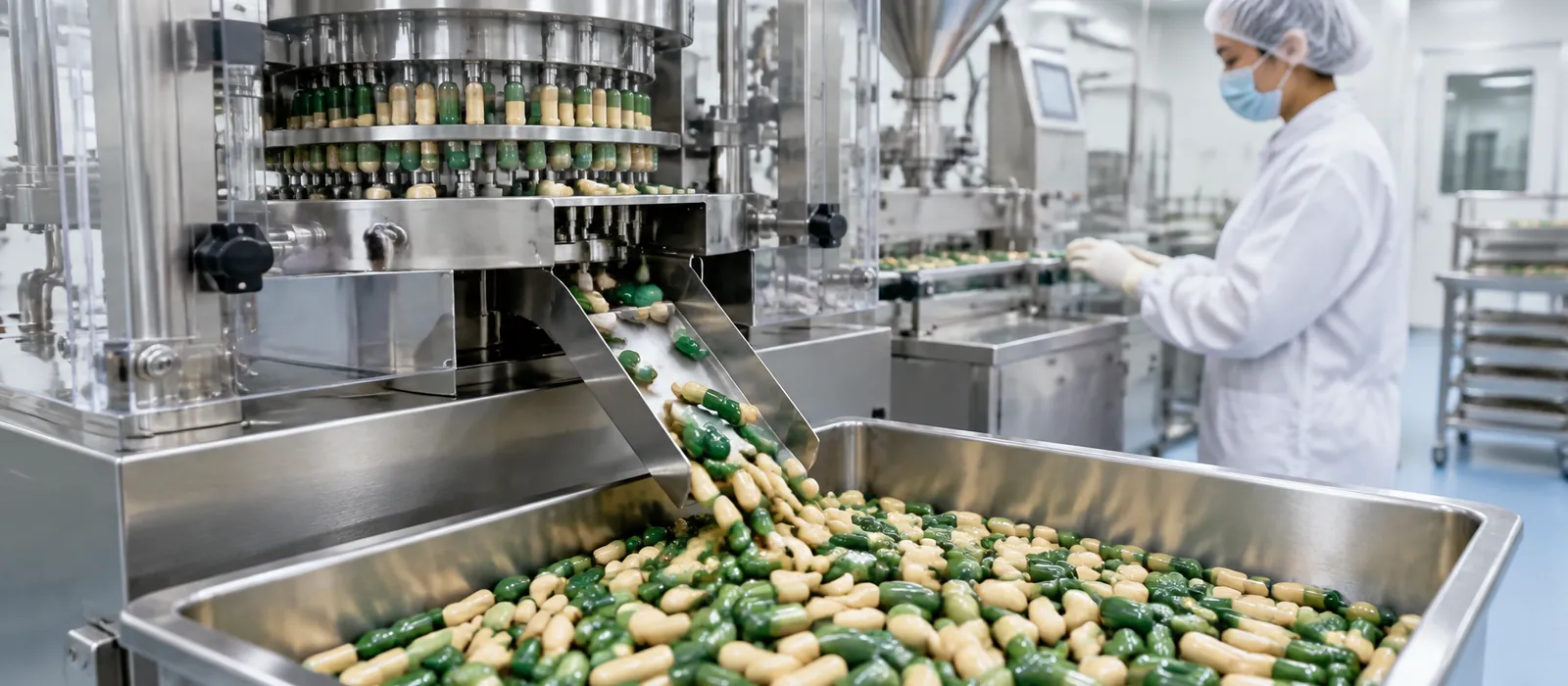
Image: Freepik
Launching a herbal supplement under your own brand usually means working with a capsule manufacturer. The right partner makes the whole thing feel easy: samples arrive on time, the capsules look and weigh the same in every bottle, and the documents are ready when a retailer or regulator asks. The wrong one can cost you months. Here's what to look at when you compare herbal capsule manufacturers, wherever they're based.
Key takeaways
- In the USA, FDA holds the brand owner ultimately responsible for GMP compliance, even when a contract manufacturer makes the product.
- Agree on the formula, capsule type and size, fill weight, excipients, tests and packaging in writing before the first batch.
- Capsule size limits the dose; concentrated extracts help when a formula won't fit.
- Domestic contract makers are faster for small runs; overseas manufacturers are often more cost-effective for larger, repeat orders.
Types of capsule manufacturers
| Domestic contract manufacturer | Overseas manufacturer | White label (stock formula) | |
|---|---|---|---|
| Formula | Yours or theirs | Yours or theirs | Fixed, theirs |
| Minimum order | Moderate to high | Moderate to high | Low |
| Lead time | Shorter | Production plus freight | Shortest |
| Unit cost at volume | Higher | Often lower | Higher per unit |
| Best for | Fast launches in one market | Established products, repeat volumes | Testing a market quickly |
Some brands buy finished, bottled capsules; others buy capsules in bulk and bottle them at home to keep labelling local. Both work. Bulk capsules can reduce freight cost and make it easier to change labels.
Who is responsible for what
In the USA, FDA has made clear in warning letters that the company selling under its own label, the "own-label distributor", is ultimately responsible for meeting dietary supplement GMP rules (21 CFR Part 111), not just its contract manufacturer. In practice, your quality unit must approve product specifications, qualify the manufacturer (often with an audit), review batch records and decide whether each batch is released. In the EU and UK, the business placing the product on the market answers for compliance, including notification where a member state requires it.
So choose a manufacturer that makes your job possible: one that shares batch records, test results and change notices without fuss.
Have a formula in mind? Send it over and we'll suggest capsule size, fill and a quote.
Share Your FormulaWhat to agree before production
- Formula and dose: each ingredient by botanical name, part and form (powder or extract), with the amount per capsule.
- Capsule type and size: HPMC for vegetarian, vegan and many halal buyers, or gelatin. A size 00 capsule holds roughly 600–750 mg of a typical herbal powder; size 0 holds less. See HPMC vs gelatin.
- Excipients: flow agents and fillers, such as rice flour or microcrystalline cellulose, with your "clean label" limits.
- Tests: identity of each ingredient, plus finished-product checks such as fill weight variation, disintegration, microbiology and heavy metals.
- Packaging: bulk drums or retail bottles, induction seals, desiccants, count per bottle.
- Labels: who prepares the supplement facts panel and checks claims for your market.
- Shelf life: how it's supported, ideally with stability data for your formula.
- Commercials: MOQ, price breaks, lead time, payment terms and Incoterms.
How a private label project runs
- Brief: formula, market, target price and volumes
- Formula review and capsule size recommendation
- Samples for appearance, taste and smell checks
- Specification sign-off and artwork, if bottled
- Production, testing and batch release documents
- Shipping with the documents your importer needs
Our private label manufacturing guide and supplement formats guide go into more detail.
A good capsule partner doesn't just fill capsules. They hand you the evidence you need to stand behind every bottle.
Herbal Capsules for Private Label
Popular herbal capsule formulas for overseas brands, supplied in bulk or packed for private label, with a certificate of analysis for every batch.
Ashwagandha Capsules
View Product
Boswellia Capsules
View Product
Bacopa Monnieri Capsules
View Product
Elderberry Capsules
View Product
Ceylon Cinnamon Capsules
View Product
Echinacea Capsules
View ProductHerbal capsules from Arizone
Arizone International LLP supplies herbal capsules to brands and distributors outside India, in bulk or packed for private labeling, and can develop formulas through our custom formulation service. Our facility holds ISO 22000:2018, GMP, HACCP, halal and US FDA food facility registration (see our certificates). Tell us your formula, capsule preference and market, and we'll come back with a recommendation and quote.
Sources: Nutritional Outlook: FDA holds distributor responsible for GMP; 21 CFR 111.70 (specifications).
Capsule Manufacturing Questions
In the USA, FDA treats the brand owner as ultimately responsible, even when a contract manufacturer makes the product. Both must follow 21 CFR Part 111.
A size 00 capsule holds roughly 600–750 mg of a typical herbal powder, depending on density. Size 0 holds less.
HPMC suits vegetarian, vegan and many halal buyers; gelatin is widely used and often slightly cheaper. Choose based on your customers and market.
Yes. Many brands import bulk capsules and bottle and label locally, which can cut freight cost and keep labelling flexible.