
Image: Freepik
Psyllium was the best-selling herbal supplement in the US mainstream market in 2024, and capsules are one of its fastest-growing formats. They are tidy, tasteless and easy to carry, which loose powder is not. The trade-off surprises many first-time buyers: one capsule holds only a small amount of fibre, so a useful serving takes several capsules and plenty of water.
In short: a typical psyllium capsule holds about 0.5–0.7 g of husk, so getting a few grams of fibre means taking several capsules, always with a full glass of water. Here is how to read the label, choose a quality product and plan a private label range.
Key takeaways
- Psyllium husk comes from the seed coat of Plantago ovata; most of the world's supply is grown in India.
- A size 00 capsule holds roughly 500–700 mg of husk powder, so servings are usually several capsules.
- Every serving must be taken with at least 240 ml (8 oz) of water; labels carry choking warnings.
- In the US, an authorised heart-health claim requires at least 7 g of soluble fibre from psyllium husk a day.
What psyllium husk capsules are
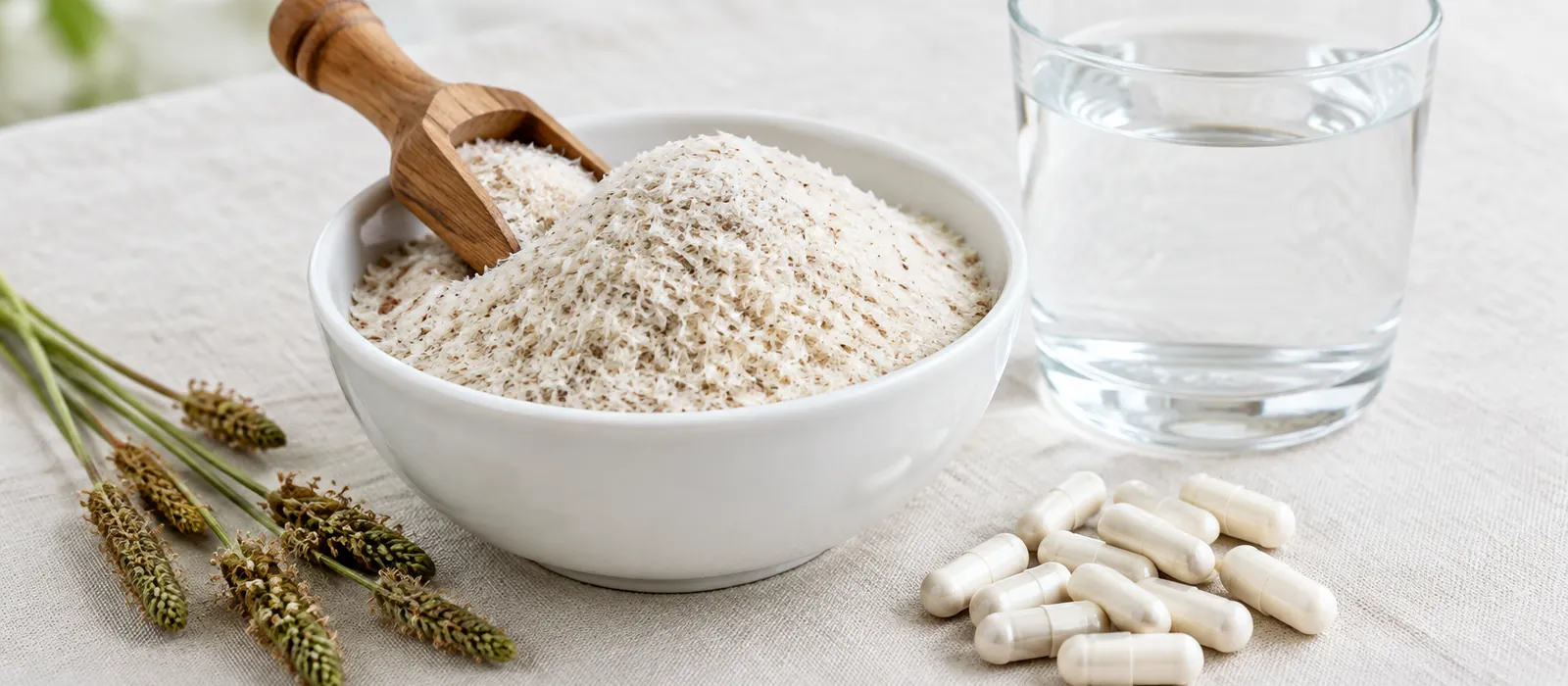
Psyllium husk is the thin outer coat of the seeds of Plantago ovata, a plant grown mainly in Gujarat and Rajasthan in India. The husk is rich in soluble fibre that forms a gel when it absorbs water. Capsules contain finely milled husk powder, sometimes blended with other fibres or probiotics.
How many capsules make a serving?
| Capsule | Husk per capsule (approx.) | Capsules for about 3 g of husk |
|---|---|---|
| Size 0 | 400–500 mg | 6–7 |
| Size 00 | 500–700 mg | 5–6 |
| Size 000 | Up to about 1,000 mg | 3–4 (large to swallow) |
Commercial labels commonly suggest three to five capsules per serving, one to three times a day. Fibre trials often use 5–15 g of psyllium a day, which shows why many people combine capsules with fibre from food, or use powder for larger amounts. Exact fill depends on the powder's density and mesh.
Why water matters
Psyllium swells as it absorbs water. Taken without enough liquid, it can swell in the throat or gut, which is why labels in the US and elsewhere carry choking warnings and instruct people to take each serving with at least a full glass (240 ml or 8 oz) of water. Psyllium can also slow the absorption of some medicines, so many labels advise taking it a couple of hours apart from them.
Need psyllium husk or finished capsules? Ask us for purity grades and a sample COA.
Request SpecsHusk purity and quality
- Purity: husk is graded by purity, commonly 85% to 99%; higher grades contain less seed and foreign matter. See psyllium husk grades explained.
- Swell volume: a simple test of how much the husk swells, linked to its fibre quality.
- Mesh size: fine powder (e.g. 40–60 mesh or finer) fills capsules more evenly.
- Microbiology, heavy metals and pesticides: results per batch.
- Allergen awareness: psyllium dust can cause allergic reactions in people handling it, so manufacturers need dust control.
Capsules vs powder
| Capsules | Powder | |
|---|---|---|
| Convenience | No taste or texture; portable | Needs mixing |
| Fibre per serving | Low per capsule; several needed | Several grams per spoon |
| Cost per gram of fibre | Higher | Lower |
| Best for | Smaller daily amounts, travel, people who dislike the texture | Larger fibre amounts |
Labels and claims by market
- USA: FDA authorises a health claim linking soluble fibre from psyllium husk to reduced risk of heart disease, based on at least 7 g of soluble fibre a day as part of a diet low in saturated fat and cholesterol, with conditions per serving. Labels also need choking and water warnings.
- EU and UK: only claims on the authorised registers may be used; check the current wording for fibre and psyllium before finalising labels.
- Everywhere: state the husk content per capsule and per serving clearly.
Private label tips
For a private label psyllium capsule, choose a high-purity, finely milled husk, a size 00 or 000 capsule, and a serving that is honest about the number of capsules. HPMC shells suit vegan customers. Blends with probiotics or prebiotic fibres are popular. Because psyllium absorbs moisture, use bottles with desiccants and good seals. Our supplement formats guide helps if you are choosing between capsules and powder.
Psyllium capsules are convenient, but the label has to be honest: how much husk per capsule, how many capsules per serving, and a full glass of water every time.
Psyllium and Digestive Wellness Products
Psyllium husk, capsules and other fibre-rich botanicals for private label and bulk buyers, with a certificate of analysis for every batch.
Psyllium from Arizone
Arizone International LLP supplies psyllium husk in bulk and makes psyllium husk capsules for private label brands outside India. Tell us the purity grade, capsule size and market, and we'll confirm the specification and documents before you order. Every batch ships with a certificate of analysis.
Sources: NutraIngredients: US herbal supplement sales 2024 (psyllium top seller); 21 CFR 101.81: soluble fibre and coronary heart disease claim.
Psyllium Capsule Questions
It depends on the capsule. Most hold about 0.5–0.7 g of husk, so labels often suggest three to five capsules per serving. Follow the product label.
At least a full glass, 240 ml or 8 oz, with every serving. Too little water can cause choking or blockage.
They contain the same husk, but less per serving, so you need several capsules to match a spoon of powder.
Many labels advise taking it a couple of hours apart from medicines, because it can slow their absorption.
From the seeds of Plantago ovata, grown mainly in Gujarat and Rajasthan in India, which supplies most of the world's psyllium.
High-purity grades, often 95% to 99%, milled to a fine, even powder for consistent capsule fills.