
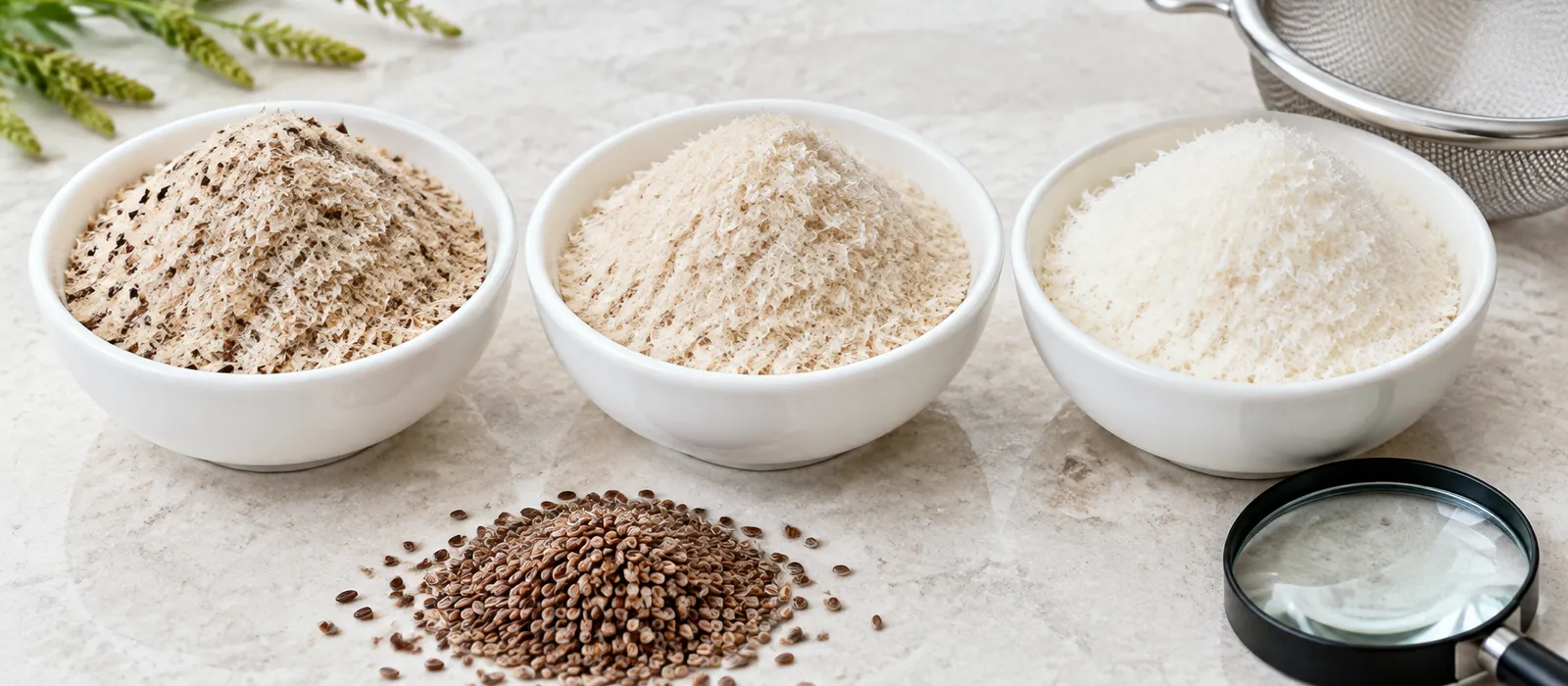
Photo: Unsplash
Ask three Indian suppliers for a psyllium husk quote and you'll probably get three different grade names: 85%, 95%, 98%, 99%, "pharma grade", "food grade", 40 mesh, 100 mesh. They aren't all describing the same thing, and the cheapest quote is often cheap for a reason. Here's what the numbers actually measure, so you can write a specification that gets you the husk your product needs, and not a more expensive one you don't.
In short: the percentage is purity, meaning how much of the material is clean husk rather than light extraneous matter, seed pieces and dust. 95% is the workhorse grade for supplements and most food use. 98–99% is for buyers who need to meet a pharmacopoeia monograph or a very tight brand spec. 85% is a lower-cost grade for feed and some industrial uses. Purity alone doesn't tell you how the husk will perform, so also specify mesh size, swell volume, moisture and microbiology.
What psyllium husk is, in one paragraph
Psyllium husk, called isabgol in India, is the thin seed coat of Plantago ovata. Western India, mainly Gujarat and Rajasthan, grows most of the world's supply. After harvest, the seeds are cleaned and milled so the husk comes away from the inner seed. The husk is then sieved and air-separated into grades. The more passes through cleaning and grading, the purer the husk, and the higher the price. That's really all a grade is: how far along that cleaning process the material went.
What the purity percentage really measures
When a supplier says "95% purity", they mean that roughly 95% of the material by weight is husk, and the remaining 5% or so is "light extraneous matter" (pinkish husk pieces still attached to bits of seed, called kha-kha or lali in the trade) plus a little heavier matter such as seed fragments and sand. It is a cleanliness figure. It is not an assay of a single compound, and it isn't a measure of fibre content.
That's why two lots of "95%" husk can still behave differently in your mixer. One may swell faster, look whiter or taste grittier. So treat the purity grade as the first line of your specification, not the whole thing.
The common grades side by side
| Grade | Typical use | What to watch |
|---|---|---|
| 85% purity | Animal feed, some industrial uses, low-cost fibre blends | More light extraneous matter, darker colour, lower swell; rarely suitable for supplements |
| 95% purity | Fibre supplements, capsules, food fortification, bakery | The most traded export grade; check swell volume and micro, not just the purity line |
| 98% purity | Brands with strict specs, many European buyers | Cleaner and lighter in colour; confirm the test method used for purity |
| 99% purity | Pharmaceutical laxatives, premium supplements | Highest price; only worth it if your regulator, monograph or brand spec demands it |
These are trade conventions, not legal definitions, and suppliers draw the lines slightly differently. Always ask for the specification sheet behind the grade name.
Food grade vs pharma grade
"Pharma grade" usually means the husk is supplied against a pharmacopoeia monograph, for example the United States Pharmacopeia (USP) or the European Pharmacopoeia (Ph. Eur.), with the tests and limits that monograph sets. "Food grade" means it meets food safety rules for your market but isn't necessarily tested against a monograph. The plant is the same. The difference is the depth of testing and the paperwork.
If you sell in the USA and want to use the FDA's authorised health claim linking soluble fibre from psyllium husk to a reduced risk of coronary heart disease, the regulation (21 CFR 101.81) sets conditions on the husk itself, including a purity of at least 95%, measured by USP methods. That's one reason 95% is the minimum grade most US supplement brands accept. If you aren't making that claim and aren't selling a medicine, paying for 99% may simply add cost without adding anything to your product.
Mesh size: husk, powder and everything in between
Purity tells you how clean the husk is. Mesh tells you how fine it is. Whole husk is sold as flakes, and husk powder is milled and sieved to a mesh size, typically somewhere between 40 and 100 mesh. A higher mesh number means a finer powder.
- Whole husk (flakes): classic retail packs and drink mixes, where a visible, natural look matters.
- 40–60 mesh powder: general supplement blends and food fortification.
- 80–100 mesh powder: capsules, where the powder must flow evenly and pack densely, and smooth-texture drinks.
Finer powder hydrates and thickens faster, which is great in a capsule and less great in a drink that has to stay pourable for a minute. Tell your supplier what the product is, not just the mesh, and they can suggest a fit. Our page on psyllium husk lists the formats we supply.
Swell volume: the test that tells you how it performs
Swell volume, also called swelling index, measures how much a fixed weight of husk expands in water, reported in millilitres per gram. It's the closest thing to a performance test for psyllium, because swelling is what the fibre is for. Two husks with the same purity can have different swell volumes depending on the crop, the processing and how finely the husk is milled.
If the swell volume matters for your product, and it nearly always does, put a minimum on your specification and ask for it on every batch COA. It's a cheap test, and it catches poor lots that a purity figure alone won't.
Moisture, micro and contaminants
Psyllium is a field crop, threshed and milled in large volumes, so a few safety tests matter as much as the grade:
- Moisture (loss on drying): keeps the husk free-flowing and stable; high moisture invites mould.
- Microbiology: total plate count, yeast and mould, E. coli and Salmonella. Many buyers require a microbial reduction step. We explain the options in steam sterilisation vs ETO vs irradiation.
- Pesticides and ethylene oxide: essential for the EU, where limits are strict and border checks are common.
- Heavy metals and aflatoxins: usually low in husk, but they should still be reported as numbers.
Our guide on how to read a certificate of analysis shows what good results look like line by line.
A specification you can copy
If you're writing a purchase spec for psyllium husk powder for capsules, something like this works as a starting point. Adjust the limits to your market and product.
| Parameter | Example requirement |
|---|---|
| Botanical source | Plantago ovata Forsk., seed husk |
| Purity | Not less than 95% (state the method) |
| Particle size | Not less than 95% through 80 mesh |
| Swell volume | Minimum agreed value in ml/g, every batch |
| Loss on drying | Maximum agreed %, every batch |
| Microbiology | TPC, yeast and mould limits; E. coli and Salmonella absent |
| Contaminants | Heavy metals, pesticides and ethylene oxide to target-market limits |
| Packing | 25 kg multi-wall paper bags or fibre drums with food-grade PE liner |
Buy the grade your product needs, then make the supplier prove it batch by batch. A clear spec costs nothing and saves arguments later.
Questions to ask before you order
- Which method do you use for purity, and can I see it on the COA?
- What swell volume do your recent lots of this grade show?
- Is the husk treated to reduce microbes, and how?
- Can you send a pre-shipment sample from the actual lot?
- Which pesticide and ethylene oxide tests do you run for the EU or the USA?
Psyllium husk from Arizone
Arizone International LLP supplies psyllium husk and psyllium husk capsules to buyers outside India, with a certificate of analysis for every batch, made under ISO 22000:2018, GMP, FSSAI and HACCP. Tell us your grade, mesh, swell volume and target market, and we'll confirm what we can supply before you place an order.
Sources: 21 CFR 101.81, health claims: soluble fiber and coronary heart disease.
Psyllium Husk Questions
It means about 95% of the material by weight is clean husk, and the rest is light extraneous matter, seed fragments and other impurities. It's a cleanliness grade, not a fibre assay.
Most supplement brands use 95% purity husk or powder. Some choose 98–99% for a cleaner, lighter product or to meet a pharmacopoeia monograph.
It's how much a gram of husk expands in water, in millilitres. It shows how well the fibre will work, so it's worth adding a minimum value to your specification.
The plant is the same. Pharma grade is supplied and tested against a pharmacopoeia monograph such as USP or Ph. Eur., while food grade meets food safety rules without necessarily following a monograph.
Fine powder, usually around 80–100 mesh, flows and packs better in capsule machines. Whole husk and coarser powders suit drink mixes and retail packs.