
Image: Freepik
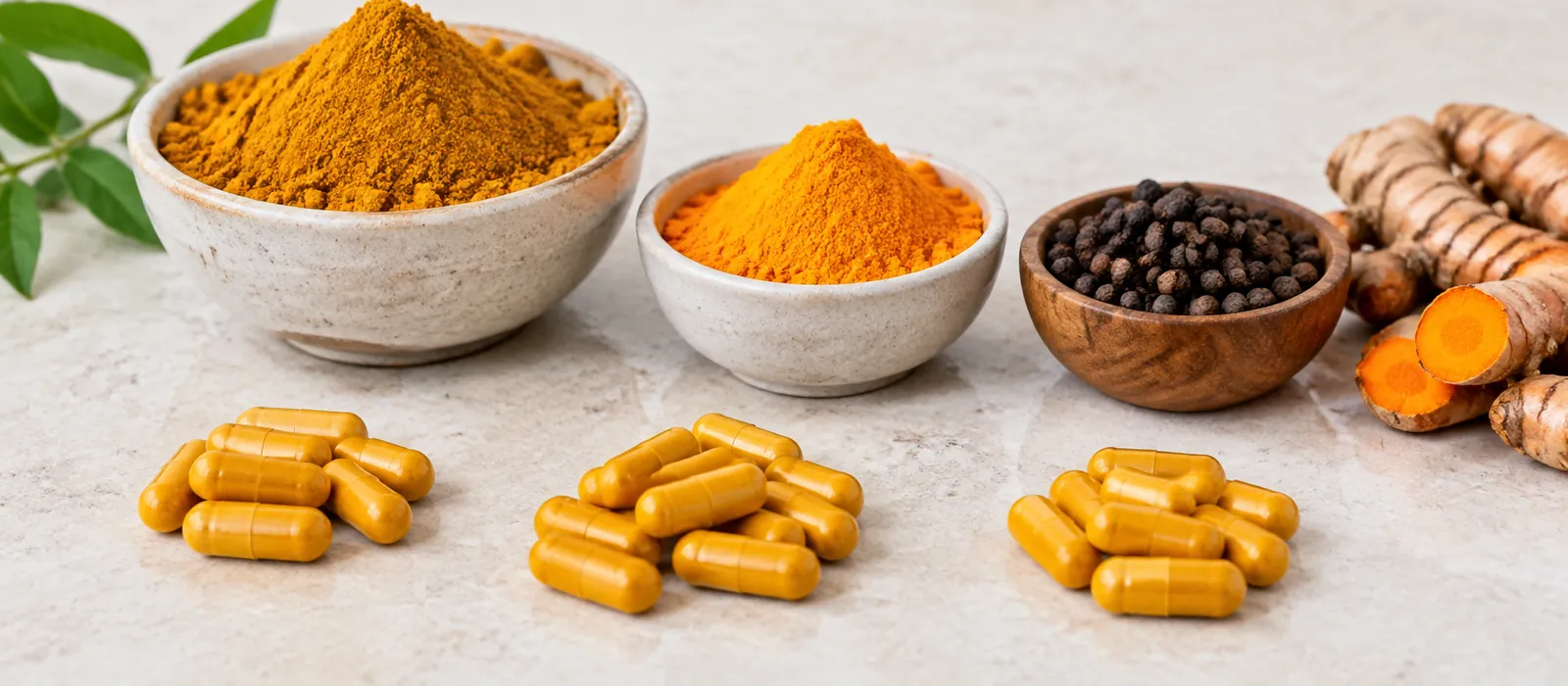
Turmeric is the top-selling supplement at the UK's biggest health retailer and a leader in the US natural channel. Yet "turmeric capsules" can mean three very different products: plain turmeric powder, a concentrated curcumin extract, or curcumin with black pepper extract. The amount of curcumin in each can differ by more than twenty times.
In short: plain turmeric powder contains only a few percent curcuminoids; curcumin 95% extracts are far more concentrated; black pepper extract (piperine) is added because curcumin on its own is poorly absorbed. Here is how to compare them, what to test and how labels differ in the US, UK and EU.
Key takeaways
- Turmeric powder is typically around 2–5% curcuminoids; curcumin extracts are standardised to about 95%.
- Piperine from black pepper is the most common way to improve curcumin absorption; other delivery systems exist.
- Lead chromate adulteration of turmeric has been documented, so heavy metal testing is essential.
- Some European regulators require extra warnings on turmeric supplements because of rare liver reports.
The three types of turmeric capsules
| Type | What it contains | Curcuminoids | Best for |
|---|---|---|---|
| Turmeric powder capsules | Dried, milled turmeric root | About 2–5% | Whole-food, traditional positioning |
| Curcumin extract capsules | Extract standardised to curcuminoids | Up to about 95% | A defined curcumin amount per capsule |
| Curcumin with piperine | Curcumin extract plus black pepper extract | Up to about 95% plus piperine | Better absorption positioning |
For the raw materials behind these products, see our guide to curcumin 95% vs turmeric extract vs turmeric powder.
How much curcumin is in each?
A size 00 capsule holds about 500–600 mg of turmeric powder. At around 3% curcuminoids, that is roughly 15–20 mg of curcuminoids per capsule. The same capsule filled with a 95% extract delivers well over 400 mg. That is why "500 mg turmeric" and "500 mg curcumin" are not the same claim, and why clear labels state curcuminoids per serving.
Why black pepper is added
Curcumin is poorly absorbed and quickly broken down in the body. Piperine, the pungent compound in black pepper, slows that breakdown, and early studies reported large increases in curcumin levels in the blood. Products typically add a few milligrams of black pepper extract standardised to piperine. Other approaches include liposomal curcumin, phospholipid complexes and water-dispersible forms. Each is a different ingredient with its own specification; see our liposomal supplements guide.
Choosing between turmeric powder and curcumin? Tell us your target and we'll suggest a formula.
Get a RecommendationQuality testing and lead
- Curcuminoids by HPLC, with the method on the COA.
- Lead and chromium: lead chromate has been found added to some turmeric to brighten its colour; see lead in turmeric.
- Synthetic curcumin: ask for proof the curcumin is plant-derived.
- Residual solvents for extracts, plus microbiology and pesticides.
Safety and warnings
Culinary turmeric is very widely used, but concentrated supplements are different. Rare cases of liver injury have been reported with turmeric and curcumin supplements, particularly high-dose or enhanced-absorption products, and some European authorities have asked for warning statements. Curcumin may also interact with blood thinners and some other medicines. Responsible labels advise people with liver or gallbladder conditions, those who are pregnant, and those taking medicines to speak to a doctor first.
Labels in the US, UK and EU
- USA: structure and function wording only; no disease claims. State curcuminoids per serving.
- EU: botanical health claims for turmeric are on hold, and some member states require additional warnings or limits for curcumin or piperine. Check national rules for each country.
- UK: GB rules apply; claims must follow the GB register.
Private label options
Common private label formats are turmeric powder capsules for a whole-herb story, curcumin 95% with piperine for a concentrated product, and blends with ginger or boswellia. Decide on the curcuminoid target, absorption approach and market first. Our capsule manufacturers guide explains the project steps.
"500 mg turmeric" and "500 mg curcumin" sound alike. In the capsule, they can differ by twenty times.
Turmeric and Curcumin Products
Turmeric capsules, curcumin capsules and raw materials for private label brands, with a certificate of analysis for every batch.

Turmeric Capsules
View Product
Curcumin Capsules
View Product
Liposomal Curcumin Capsules
View ProductCurcumin Extract
View ProductTurmeric Extract
View Product
Ginger Capsules
View Product
Boswellia Capsules
View ProductTurmeric capsules from Arizone
Arizone International LLP makes turmeric capsules, curcumin with piperine capsules and supplies curcumin extract in bulk to brands outside India. Every batch is tested for curcuminoids and heavy metals and ships with a certificate of analysis.
Sources: NutraIngredients: Holland & Barrett trends (turmeric top seller); Darwin Nutrition: curcumin buying guide; ABC-AHP-NCNPR Botanical Adulterants Prevention Program.
Turmeric Capsule Questions
Turmeric capsules contain the ground root, with only a few percent curcuminoids. Curcumin capsules contain an extract standardised to about 95%.
Piperine from black pepper slows the breakdown of curcumin, which is otherwise poorly absorbed.
Roughly 15–20 mg of curcuminoids in a 500 mg capsule of turmeric powder at around 3%, compared with over 400 mg from a 95% extract.
Most people tolerate them, but rare liver reports exist and curcumin can interact with blood thinners. Check with a doctor if you take medicines.
Lead chromate has been added to some turmeric to improve its colour, so heavy metal testing is essential.
It depends on positioning: powder for a whole-herb story, curcumin with piperine for a concentrated product.