
Image: Freepik
"Liposomal" has become one of the busiest words on supplement shelves in the USA and Europe: liposomal vitamin C, curcumin, glutathione, CoQ10, NAD+, ashwagandha. The promise is better absorption. Some products deliver real liposomes and can back it up; others use the word for little more than an added emulsifier. If you're planning a liposomal range under your own brand, here's what the term should mean and the data worth asking for before you print it on a label.
In short: a liposome is a tiny vesicle made of phospholipids that can carry an ingredient inside it. A credible liposomal product comes with data: particle size, encapsulation efficiency, the phospholipid source and amount, and ideally a human absorption study. Without that data, "liposomal" is a marketing word, and absorption claims are hard to defend.
What a liposome is
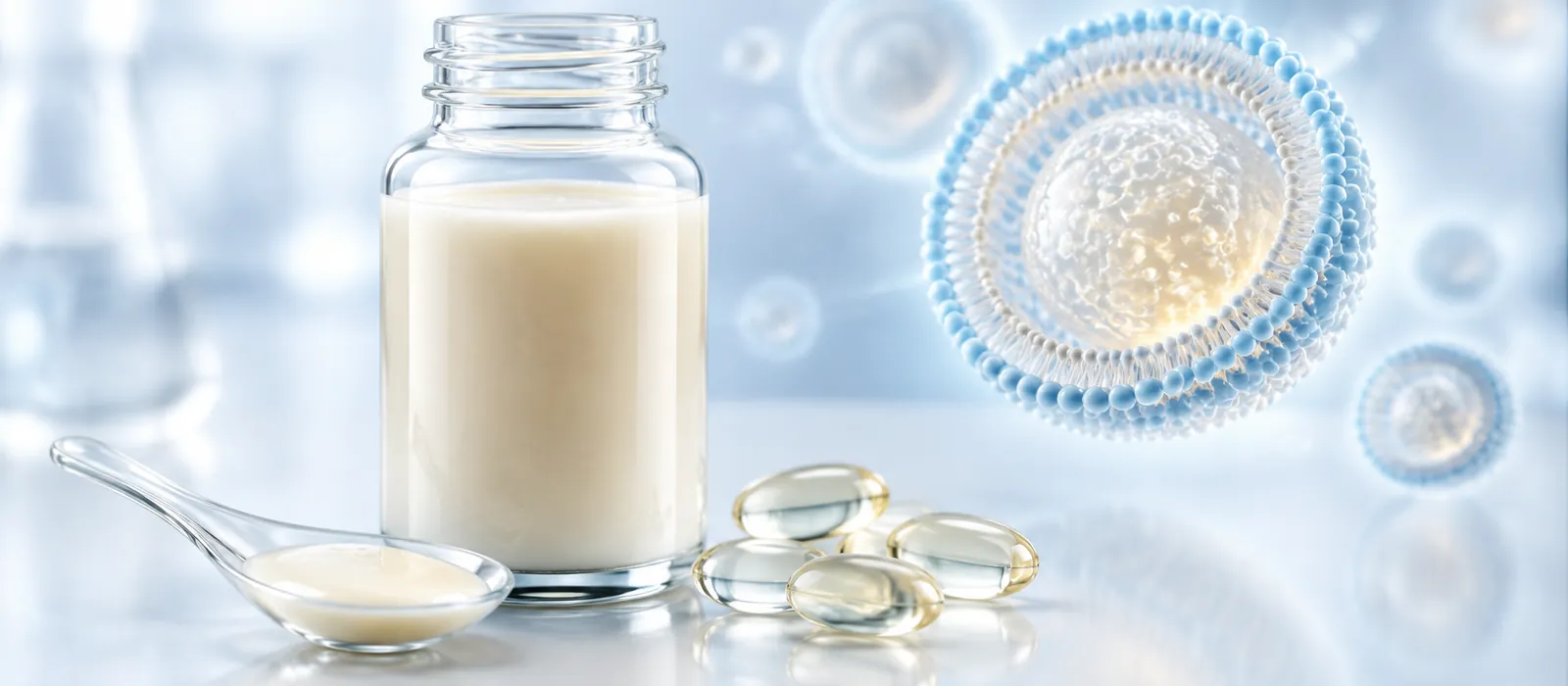
Phospholipids, the same molecules that make up cell membranes, naturally form double layers in water. Under the right conditions, those layers close into small spheres called liposomes. Water-soluble ingredients can sit in the watery core; fat-soluble ones can sit within the phospholipid layer. The idea is that this packaging protects the ingredient through digestion and helps it get absorbed. The common phospholipid sources are sunflower and soy lecithin, often in a purified form rich in phosphatidylcholine.
Not all "liposomal" products are the same
| Type | What it is | Points to note |
|---|---|---|
| Liquid liposomal dispersion | Liposomes suspended in liquid | The classic format; sensitive to heat, needs stability data |
| Dried liposomal powder in capsules | Liposomes dried with a carrier, re-forming in water | Convenient; ask whether liposomes re-form and at what size |
| Phospholipid complex | Ingredient bound to phospholipids, not enclosed in a vesicle | A real technology, but a different one; shouldn't be called liposomal unless it is |
| Ingredient + lecithin blend | Simple mix with no vesicles | The weakest version; absorption claims need proof |
The data to ask for
- Particle size and distribution: measured by dynamic light scattering, reported in nanometres with a polydispersity index. Published reviews treat particle size as a key factor for stability and release.
- Encapsulation efficiency: the share of the active actually inside the liposomes, usually by separating free from encapsulated material and testing by HPLC. Reported values in research vary widely.
- Phospholipid source and content: sunflower or soy, and how much per serving. Soy must be declared as an allergen in the EU, the UK and the USA.
- Stability: particle size and active content over the shelf life, at the storage conditions on the label.
- Human data: a bioavailability study on the actual formulation is the strongest support. For example, a crossover study of one liposomal vitamin C reported about 1.8 times higher bioavailability than standard vitamin C. Results don't transfer automatically from one product or ingredient to another.
Claims and labelling
"Better absorption" isn't a disease claim, but in both the EU and the USA, marketing claims must be truthful and substantiated. If you say "up to X times better absorbed", you need data on your formula, not a borrowed study on another product. Keep health claims within your market's rules; see EU health claims for botanicals.
Capsule choices for liposomal products
Dried liposomal powders are usually filled into HPMC or gelatin capsules. If you sell to vegetarian, vegan, halal or kosher customers, plant-based HPMC capsules keep things simple. See HPMC vs gelatin capsules.
A real liposomal product comes with numbers: size, encapsulation and stability. If the supplier can't show them, sell it as what it is.
Liposomal capsules from Arizone
Arizone International LLP supplies liposomal capsules for private label and bulk buyers, including liposomal ashwagandha, liposomal curcumin, liposomal CoQ10 and liposomal berberine. Tell us the active, dose, capsule type and the data your regulatory team needs, and we'll confirm the specification and documents available. See our private labeling page for how projects run.
Liposomal Questions
It should mean the active is carried in liposomes, tiny vesicles made of phospholipids. The term isn't regulated, so ask for data that shows real liposomes are present.
It depends on the product. Dried liposomal powders can re-form liposomes in water, but you should see particle size and stability data for the specific formula.
The percentage of the active ingredient that is actually inside the liposomes, measured by separating free and encapsulated material and testing by HPLC.
They can. Soy lecithin is a common phospholipid source and must be declared as an allergen in the EU, the UK and the USA. Sunflower lecithin avoids this.