
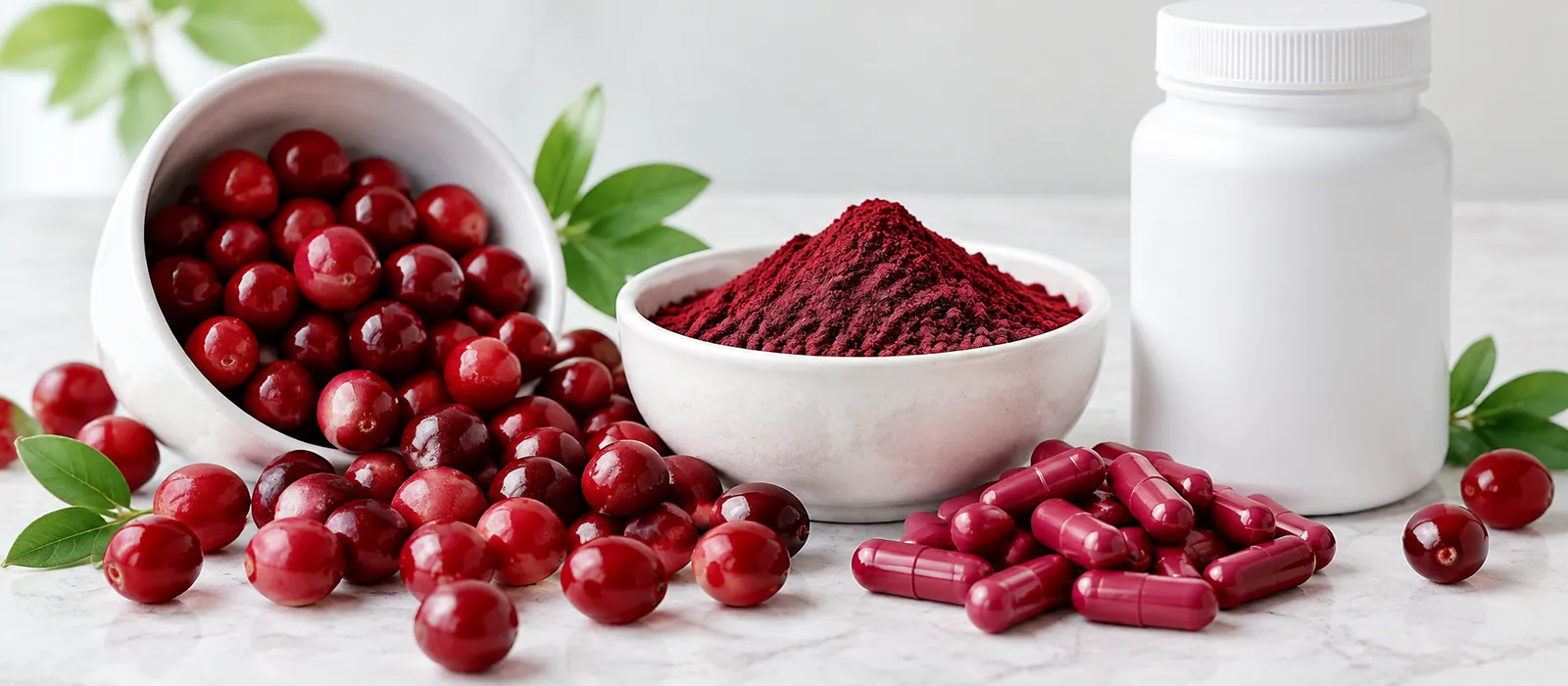
Image: Freepik
Cranberry capsules are one of the most searched supplements in the US, UK and Europe, and for good reason: they are a simple, sugar-free alternative to cranberry juice. But the shelf is confusing. One product says "500 mg cranberry", another "36 mg PACs", another "25:1 extract", and they are not the same thing at all.
In short: the number that matters most in a cranberry capsule is its proanthocyanidin (PAC) content, and that number only means something when the lab method is stated. This guide explains PACs, the 36 mg figure, how to read a label and what brands should check before they buy cranberry powder or extract in bulk.
Key takeaways
- Cranberry capsules contain dried cranberry (Vaccinium macrocarpon) as juice powder, whole-fruit powder or a concentrated extract.
- PACs, especially A-type PACs, are the compounds most studies focus on.
- The often-quoted 36 mg of PACs a day refers to the DMAC method; other methods can give results several times higher for the same material.
- Health claims differ by market: the US allows a carefully worded qualified claim, while EU authorities have not authorised cranberry claims.
What are cranberry capsules?
Cranberry capsules are dietary supplements filled with dried American cranberry, Vaccinium macrocarpon. They let people take cranberry without the sugar and volume of juice. Most capsules hold 250–500 mg of material, but the strength of that material varies enormously, from plain fruit powder to extracts concentrated 25 or 50 times.
PACs and the 36 mg figure
Proanthocyanidins (PACs) are polyphenols found in cranberries. Cranberry is unusual because many of its PACs are "A-type", a structure that has been the focus of most cranberry research.
The figure of 36 mg of PACs a day comes from France, where the food safety agency (Afssa) reviewed cranberry products in 2004. That figure is tied to the DMAC laboratory method. French authorities later confirmed DMAC as the method for checking products that use the 36 mg reference, because other assays can give results that differ by up to five times for the same material.
What this means in practice: a capsule claiming "36 mg PACs" by an unnamed or different method may contain far less than a product tested by DMAC. Always ask which method was used.
Powder vs juice powder vs extract
| Type | What it is | Typical PAC level | Notes |
|---|---|---|---|
| Whole-fruit powder | Dried, milled cranberries | Low | Natural, but large doses needed |
| Juice powder | Dried juice concentrate, often on a carrier | Low to moderate | Common in budget capsules |
| Standardised extract | Concentrated to a stated PAC content | Higher, stated on the COA | Best for a defined daily amount |
"500 mg cranberry" on a label tells you the weight of the material, not its strength. "Equivalent to 12,500 mg fresh fruit" describes a ratio, which is also not a PAC figure.
Planning a cranberry capsule? Tell us your PAC target and we'll suggest an extract and capsule size.
Get a RecommendationHow to read a cranberry capsule label
- PAC content per daily serving, ideally with the method named (DMAC or BL-DMAC).
- Type of cranberry ingredient: extract, juice powder or fruit powder.
- Number of capsules per day: some products split 36 mg across two capsules.
- Other ingredients, such as D-mannose, vitamin C or probiotics, which change how the product is positioned.
- Capsule shell: HPMC for vegetarian and vegan customers; see our HPMC vs gelatin guide.
Adulteration and testing
Because PACs are measured, cheaper PAC-rich materials such as grape seed or peanut skin extract can be blended into "cranberry extract" to boost the number. The ABC-AHP-NCNPR Botanical Adulterants Prevention Program has flagged cranberry products among those at risk. Buyers should ask for:
- PACs by DMAC, plus a method that confirms the A-type PAC profile typical of cranberry
- An identity test for Vaccinium macrocarpon
- Heavy metals, pesticides and microbiology per batch
Our guide to adulteration and identity testing explains the tests in more detail.
Claims in the US, UK and EU
- USA: in 2020 FDA allowed a qualified health claim for cranberry juice and cranberry dietary supplements relating to recurrent urinary tract infections in healthy women, with mandatory wording that the evidence is limited and inconsistent. Any other wording must stay within structure and function rules.
- EU and UK: EFSA did not authorise the cranberry claims submitted to it, so urinary tract claims cannot be used on food supplements. Cranberry is sold for its taste, polyphenols and general wellbeing positioning instead.
- Everywhere: cranberry products must not be presented as a treatment for infections.
Making cranberry capsules for your brand
For a private label cranberry capsule, decide on the PAC target and method first, then choose the extract and capsule size that delivers it in one or two capsules. Many brands pair cranberry with D-mannose or vitamin C. Plan for stable packaging, because fruit extracts can absorb moisture, and keep claims within your market's rules. Our herbal capsule manufacturers guide covers the project steps.
With cranberry capsules, ask two questions before anything else: how many milligrams of PACs, and measured by which method?
Cranberry and Fruit Capsules
Cranberry capsules and other fruit-based capsules for private label brands, with a certificate of analysis for every batch.
Cranberry Capsules
View Product
Bilberry Capsules
View Product
Elderberry Capsules
View Product
Acerola Capsules
View Product
Pomegranate Capsules
View Product
Raspberry Capsules
View Product
Acai Berry Capsules
View Product
Wild Cherry Capsules
View ProductCranberry capsules from Arizone
Arizone International LLP makes cranberry capsules for private label brands and distributors outside India, in HPMC or gelatin shells, bottled or in bulk. Tell us your PAC target, test method and market, and we'll confirm the specification before you order. Every batch ships with a certificate of analysis.
Sources: Afssa / DMAC method summary (Le Quotidien du Pharmacien); ABC-AHP-NCNPR Botanical Adulterants Prevention Program.
Cranberry Capsule Questions
Proanthocyanidins, polyphenols found in cranberries. Cranberry is rich in A-type PACs, the compounds most cranberry research focuses on.
It is a daily amount of PACs referenced by French authorities, measured by the DMAC method. Other methods give results that are not comparable.
Capsules avoid the sugar and volume of juice and can deliver a defined PAC amount, provided the product states its PAC content and method.
It depends on the product's strength. Follow the label, which should state the PAC content per daily serving.
In the US only a specific qualified claim is allowed. In the EU and UK, cranberry claims have not been authorised.
Yes. Cheaper PAC sources can be blended in, so buyers should test PACs by DMAC and confirm the cranberry profile.