
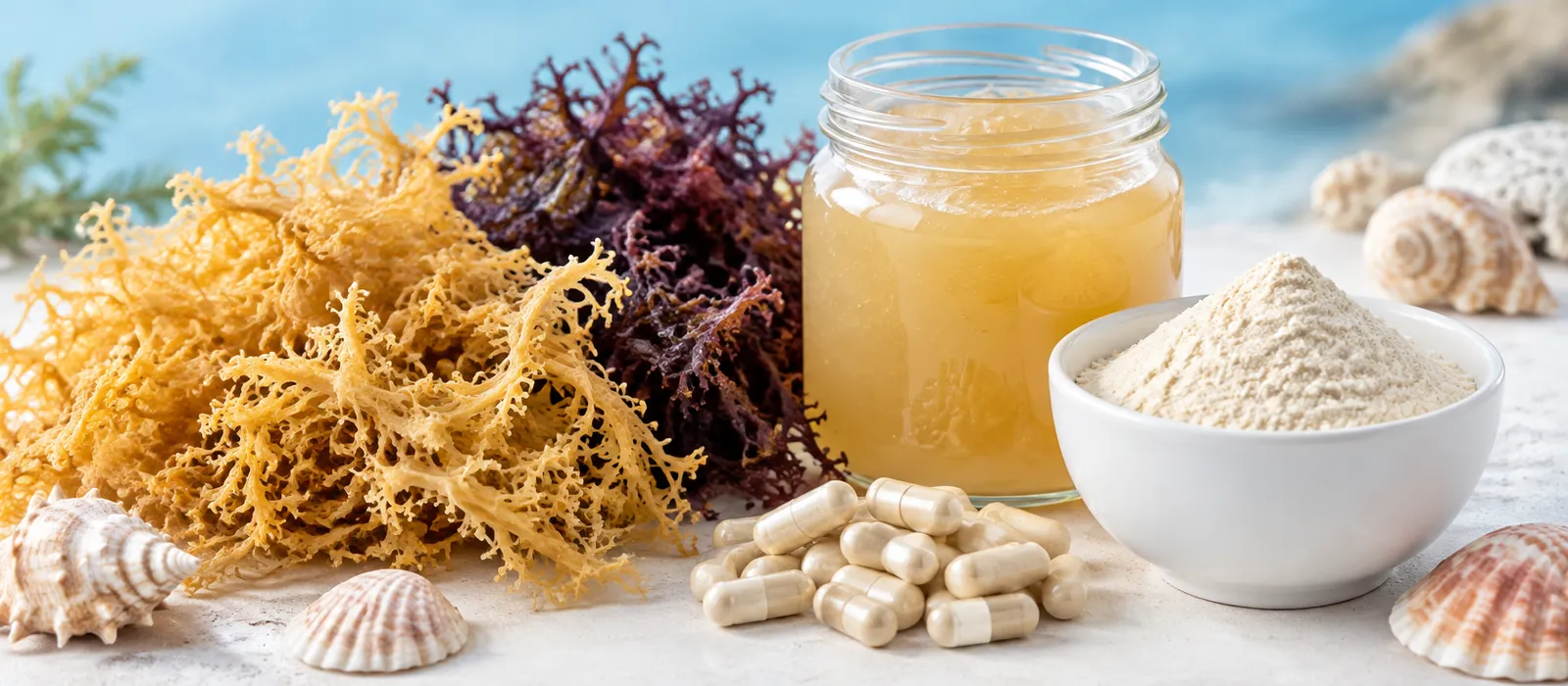
Image: Freepik
Sea moss went from Caribbean drink to global trend in a few years, carried by social media in the US and UK and now popular in Europe and Latin America too. Gels, capsules, gummies and powders are everywhere. For brands, sea moss is less simple than it looks: the name covers several seaweeds, and seaweeds can carry a lot of iodine and pick up metals from the sea.
Key takeaways
- "Irish moss" is Chondrus crispus from the North Atlantic, but much commercial sea moss is Gracilaria or Eucheuma from warm waters.
- Iodine varies widely between batches and species. Label the iodine per daily dose and keep it within safe limits.
- Seaweed can accumulate arsenic, cadmium, lead and mercury, so test every batch.
- Name the species on the specification and the label.
Which seaweed is "sea moss"?
| Name used | Species | Where it grows |
|---|---|---|
| Irish moss | Chondrus crispus | Cold North Atlantic coasts |
| "Sea moss", "golden sea moss" | Gracilaria species | Warm waters, often farmed |
| "Sea moss" (some products) | Eucheuma / Kappaphycus | Tropical seaweed farms |
| Bladderwrack (often paired) | Fucus vesiculosus | North Atlantic and North Sea |
All can be legitimate ingredients, but they are not interchangeable. A label that says "Irish sea moss" should contain Chondrus crispus.
Iodine: the number that matters most
Seaweeds concentrate iodine from seawater, and levels can differ many times over between species and harvests. Too little is not a safety problem; too much can upset thyroid function. When Austria's food safety agency tested 29 algae products, five had iodine levels that were too high and five lacked adequate labelling, such as iodine warnings.
- Test iodine on every batch and calculate it per daily serving.
- Compare with the limits in your market; EU and Australian authorities use an adult upper limit of 600 µg a day, the US 1,100 µg.
- Bladderwrack is usually far higher in iodine than sea moss, so blends need careful maths.
Planning a sea moss product? Ask for specs with iodine and heavy metal results.
Request SpecsHeavy metals
Seaweed can take up arsenic, cadmium, lead and mercury from the water. EU contaminant rules include specific limits for food supplements made only from dried seaweed, and buyers elsewhere usually apply similar limits. Ask for results as numbers, including inorganic arsenic where your market requires it, and for the harvest area. Clean, monitored waters and good washing reduce the risk.
Formats and labelling
- Dried raw sea moss: for gels made by the consumer or a co-packer; check sand and shell fragments.
- Powder: easier to dose, capsule and blend.
- Capsules: often combined with bladderwrack and burdock root, so check each ingredient's iodine.
- Labels: species, iodine per serving and a thyroid warning are good practice in every market.
For other greens, see our spirulina vs chlorella guide.
Buyer checklist
- Species name and harvest area on the specification
- Iodine result for every batch, calculated per daily dose
- Arsenic, cadmium, lead and mercury as numbers
- Microbiology, sand and foreign matter
- Label with species, iodine content and warnings
With sea moss, the species and the iodine number tell you more than any marketing photo.
Sea Vegetables and Green Superfoods
Sea moss, bladderwrack and green superfood powders for supplement brands, with a certificate of analysis for every batch.
Sea Moss Capsules
View Product
Bladderwrack Capsules
View ProductBladderwrack Powder
View ProductSpirulina Powder
View ProductChlorella Powder
View ProductMoringa Leaf Powder
View ProductSea moss and seaweeds from Arizone
Arizone International LLP supplies sea moss capsules, bladderwrack and green superfood powders to brands outside India. Tell us the species, format and market, and we'll confirm iodine and heavy metal documentation before you order. Every batch ships with a certificate of analysis.
Sources: AGES (Austria): heavy metals, arsenic and iodine in algae; National Geographic: sea moss; Regulation (EU) 2023/915.
Sea Moss Questions
Not always. Irish moss is Chondrus crispus, but many products sold as sea moss are Gracilaria or Eucheuma seaweeds.
Seaweeds concentrate iodine and levels vary widely. Too much can affect thyroid function, so test and label it per serving.
EU and Australian authorities use 600 µg a day for adults; the US uses 1,100 µg. Check the limit in your market.
It can. Seaweed takes up arsenic, cadmium, lead and mercury from water, so ask for batch results.
Yes, but bladderwrack is usually much higher in iodine, so calculate the total iodine of the blend carefully.