
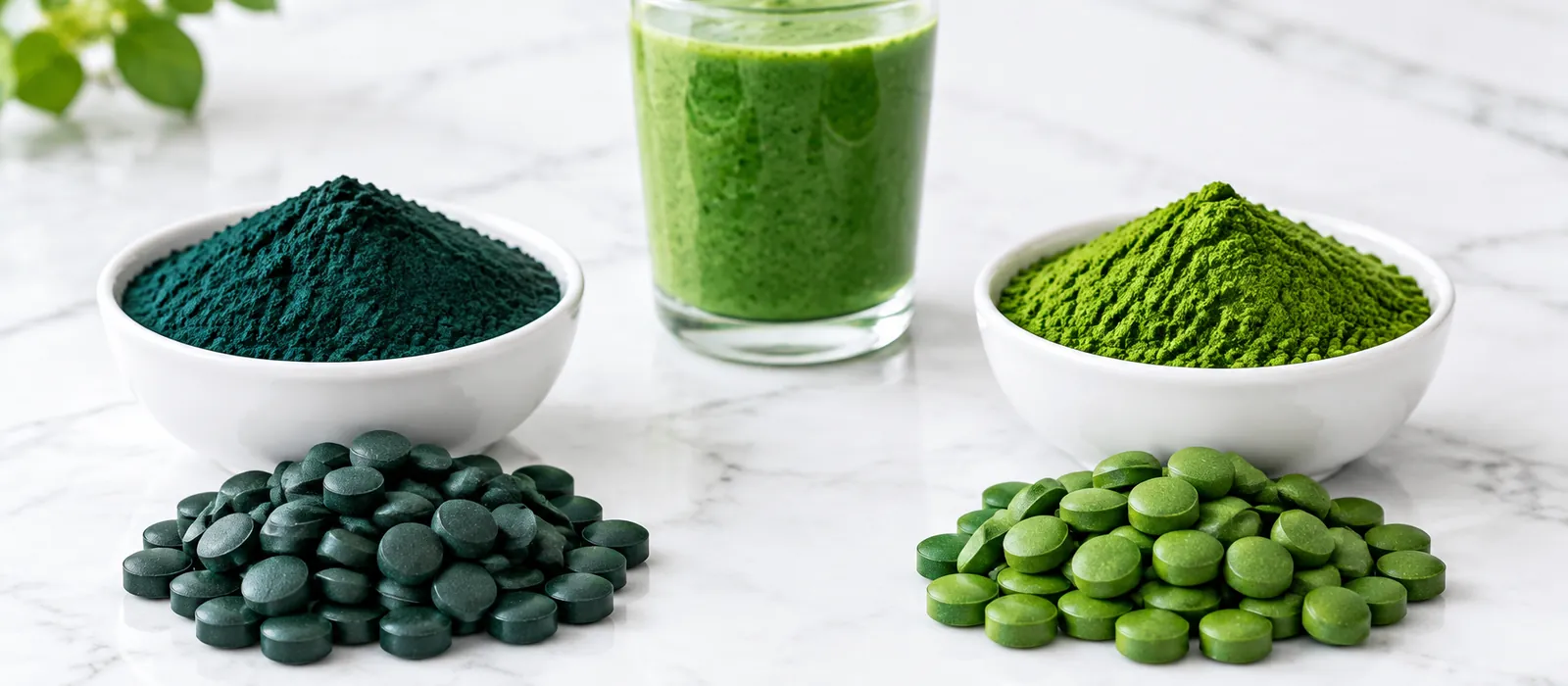
Photo: Unsplash
Spirulina and chlorella are the two classic "green superfoods". They turn up in smoothie blends, protein bars and greens powders across the US, UK, Europe and Brazil, where both are well known. They look similar in a bowl, but they are different organisms with different quality risks, and buyers who treat them as interchangeable can get caught out.
Key takeaways
- Spirulina (Arthrospira platensis) is a cyanobacterium; chlorella (Chlorella vulgaris) is a green alga with a tough cell wall.
- Chlorella should be supplied as "broken" or "cracked" cell wall powder.
- Spirulina grown in open ponds needs testing for microcystins, toxins made by other blue-green algae.
- Both need heavy metal results per batch, and B12 claims need proof of the active form.
Side-by-side comparison
| Spirulina | Chlorella | |
|---|---|---|
| Organism | Arthrospira platensis, a cyanobacterium | Chlorella vulgaris, a single-celled green alga |
| Colour and taste | Blue-green; earthy, slightly sea-like | Deep green; grassy |
| Cell wall | Soft, easily digested | Hard; must be cracked for good digestibility |
| Signature pigment | Phycocyanin (the blue in "blue spirulina") | Chlorophyll |
| Main risks | Microcystins, heavy metals | Uncracked cells, heavy metals |
Quality risks and tests
- Microcystins: other blue-green algae can grow in open spirulina ponds and produce these liver toxins. Ask for microcystin results on every batch.
- Heavy metals: both organisms absorb metals from water and nutrients. Lead, cadmium, mercury and arsenic should be reported as numbers.
- Microbiology: total plate count, coliforms and pathogens, especially for powders used in drinks.
- Cell wall (chlorella): ask how the wall is broken and for evidence such as digestibility or microscopy.
- B12: much of the B12 in spirulina is an inactive analogue. Any B12 claim needs lab proof of the active form.
Our bulk powder guide covers mesh, moisture and packaging for green powders too.
Buying spirulina or chlorella in bulk? Ask for specs with microcystin and metals results.
Request SpecsHow they are grown
Spirulina is usually farmed in shallow open ponds in warm, sunny regions, including India, China and the Americas; closed photobioreactors give tighter control at higher cost. Chlorella is grown in ponds or fermentation tanks, then its cell wall is cracked mechanically before drying. Water quality, pond hygiene and drying temperature decide much of the final quality, so ask suppliers how and where their material is grown.
Rules and claims by market
- USA: sold as foods and dietary supplements; brands handle identity testing under FDA GMP rules.
- EU and UK: both have a long history of food use. EU contaminant limits apply, and nutrition or health claims must follow the authorised lists.
- Brazil: supplement ingredients must appear on ANVISA's positive lists (IN 28/2018); check the current status of each algae ingredient.
Buyer checklist
- Species and growing system (open pond or closed)
- Microcystin results for spirulina
- Cracked cell wall evidence for chlorella
- Heavy metals and microbiology per batch
- Protein, moisture and colour specifications
Spirulina and chlorella look alike in the bowl. On the COA, they are two very different products.
Green Superfood Powders and Capsules
Spirulina, chlorella and green powders for supplement and food brands, with a certificate of analysis for every batch.
Spirulina Powder
View Product
Spirulina Capsules
View ProductChlorella Powder
View ProductMoringa Leaf Powder
View ProductWheatgrass Powder
View ProductBarley Grass Powder
View Product
Wheatgrass Capsules
View ProductBarley Grass
View ProductGreen powders from Arizone
Arizone International LLP supplies spirulina, chlorella and other green powders to supplement and food brands outside India, in bulk or as capsules. Tell us the specification and market, and we'll confirm the tests and documents before you order. Every batch ships with a certificate of analysis.
Sources: Regulation (EU) 2023/915 on contaminants; ANVISA RDC 243/2018; 21 CFR 111.75.
Spirulina and Chlorella Questions
Spirulina is a cyanobacterium with a soft cell wall; chlorella is a green alga with a hard cell wall that has to be cracked.
Toxins made by some blue-green algae that can contaminate open spirulina ponds. Buyers should ask for batch results.
Chlorella processed to crack its tough outer wall, so its nutrients are easier to digest.
Much of its B12 is an inactive analogue, so B12 claims need lab proof of the active form.
They can absorb metals from water, so ask for lead, cadmium, mercury and arsenic results per batch.