
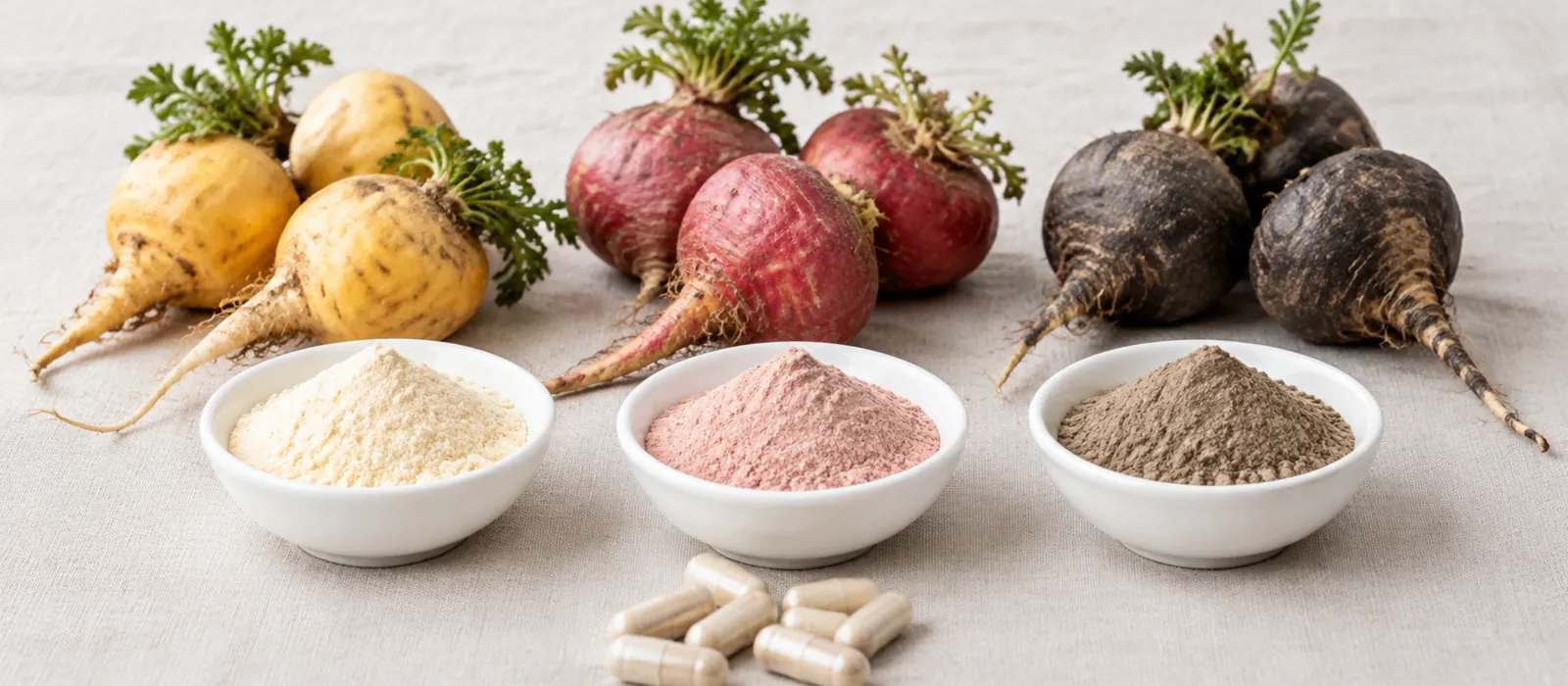
Image: Freepik
Maca is a root vegetable from the high Andes of Peru that has become a global favourite in powders, smoothies, energy bars and capsules. It sells well in the US, UK and Europe, and in Brazil and the rest of Latin America it is a familiar wellness food. For brands, the choices are colour, raw or gelatinised, and powder or extract.
In short: maca (Lepidium meyenii) comes in yellow, red and black types. Gelatinised maca is cooked to remove much of the starch, which many people find easier to digest. Quality depends on identity, origin, microbiology and contaminants.
Key takeaways
- Maca is the root of Lepidium meyenii, traditionally grown at high altitude in Peru.
- Yellow maca is most common; red and black maca are sold as premium types.
- Gelatinised maca is heat-processed to reduce starch; raw maca keeps more of its natural enzymes.
- Microbiology is a key quality issue for root powders, so ask how it is controlled.
What maca is
Maca (Lepidium meyenii) is a turnip-like root in the brassica family, grown at 3,500–4,500 metres in the Peruvian Andes, where it has been eaten for centuries. It is now also cultivated elsewhere, including China. Origin is a selling point for many brands, so make sure your supplier documents it.
Yellow, red and black maca
| Type | Share of crop | Typical positioning |
|---|---|---|
| Yellow maca | Most common | General wellness and energy |
| Red maca | Smaller share | Premium; often marketed to women |
| Black maca | Rarest | Premium; often marketed to men |
Colour-specific products need identity and documentation from the supplier, since colours can be mixed.
Raw vs gelatinised maca
Raw maca powder is simply dried and milled root. Gelatinised maca is cooked and pressure-processed to break down starch, then dried and milled, which makes it more concentrated and easier on digestion for many people. Gelatinisation also reduces microbial load. Extracts are concentrated further and are less common.
Choosing between raw and gelatinised maca? Ask for our specifications and samples.
Request SpecsGlucosinolates and macamides
Maca contains glucosinolates, typical of the brassica family, and macamides and macaenes, compounds rarely found in other plants. Some specifications state glucosinolates or macamides, measured by HPLC, but there is no single universal standard, so agree markers with your supplier if you want them.
Quality and testing
- Identity of Lepidium meyenii root, colour and origin
- Raw or gelatinised, and the process used
- Microbiology: total plate count, yeast and mould, pathogens
- Heavy metals and pesticide residues
- Moisture and mesh size for capsules and drink mixes
Our bulk herb powder guide covers the general quality checks.
Labels and claims
- USA: structure and function wording only, with the FDA disclaimer.
- EU and UK: maca has a history of food use and is sold as a food and supplement ingredient; no authorised health claims exist, so keep wording general.
- Brazil: check ANVISA's lists for supplement ingredients.
- Private label: maca suits capsules (often 500 mg per capsule), drink powders and blends with ashwagandha or ginseng; see our herbal capsule manufacturers guide.
Maca is simple to sell and easy to over-promise. Colour, process and microbiology are what make a good maca product.
Maca and Vitality Ingredients
Maca powder and capsules, plus ingredients often paired with them, with a certificate of analysis for every batch.



Maca from Arizone
Arizone International LLP supplies maca root powder and makes maca capsules for private label brands outside India. Tell us the colour, process and market, and we'll confirm the specification and documents before you order.
Sources: Future Market Insights: maca extract sourcing; ANVISA RDC 243/2018.
Maca Questions
The root of Lepidium meyenii, a brassica-family plant traditionally grown at high altitude in the Peruvian Andes.
They are colour types of the same plant. Yellow is most common; red and black are rarer and sold as premium types.
Maca cooked and pressure-processed to break down starch, making it more concentrated and easier to digest for many people.
Raw keeps more natural enzymes; gelatinised is easier on digestion and has lower microbial load.
Identity, microbiology, heavy metals, pesticides, moisture and mesh size.
No authorised health claims exist for maca, so keep wording general.