
Photo: Unsplash
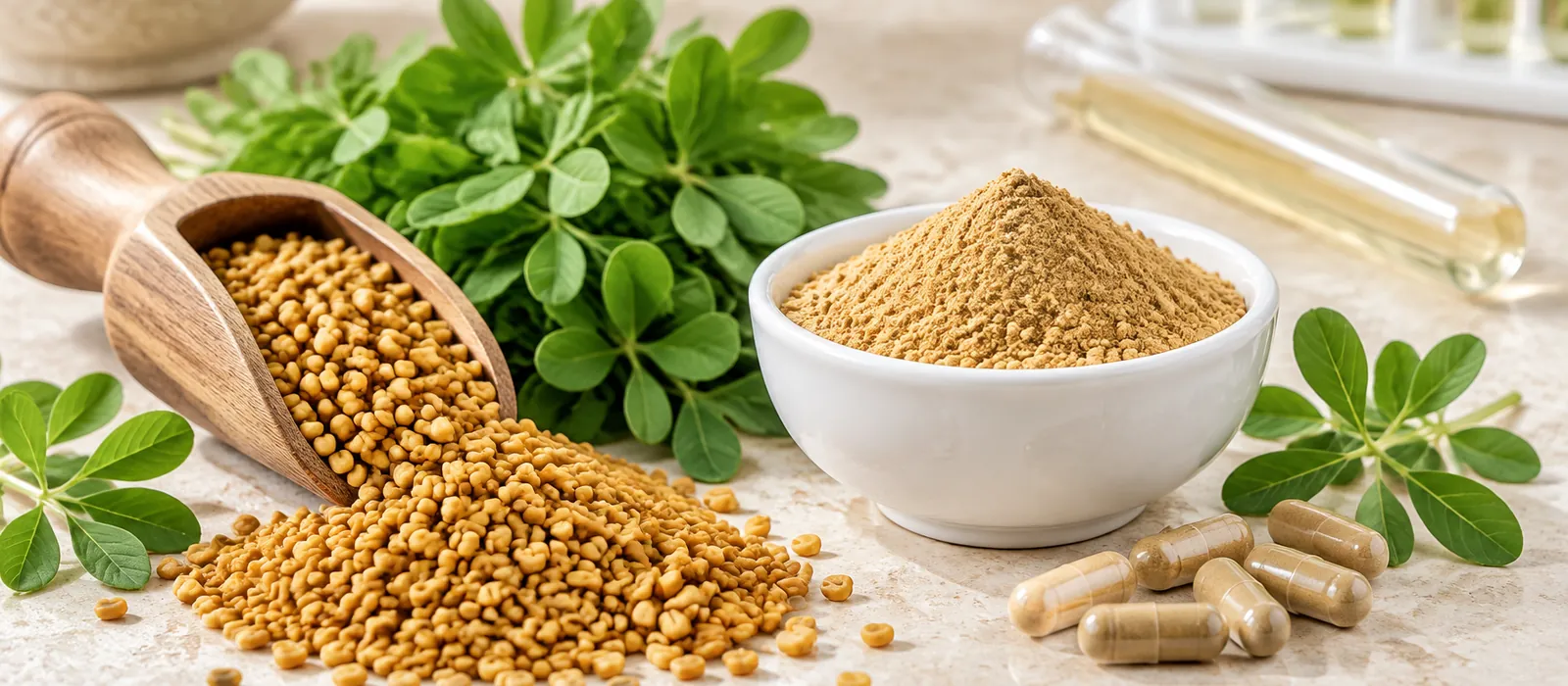
Fenugreek, methi in Hindi, is a kitchen staple across India and one of the country's big spice exports. As a supplement ingredient it's sold for very different purposes: sports and men's health products, blood sugar support blends, lactation teas, and fibre products. That's why "fenugreek seed extract" can mean several quite different powders, each standardised to a different compound. If you don't say which one you want, you may not get it.
In short: fenugreek extracts are usually standardised to furostanol saponins, to 4-hydroxyisoleucine, or sold as fibre (galactomannan). Decide which compound fits your product, then specify it with a named test method, because saponin results in particular vary widely between methods. Add identity, contaminant tests and allergen information.
What's in a fenugreek seed
Fenugreek seeds from Trigonella foenum-graecum contain several groups of compounds that matter commercially:
- Steroidal saponins, especially furostanol saponins such as protodioscin. These are the usual marker for sports and men's health extracts.
- 4-Hydroxyisoleucine (4-HIL), an unusual amino acid present in the seed at well under 1%, used as the marker for blood sugar support extracts.
- Galactomannan, a soluble fibre that makes up a large part of the seed and is sold as fenugreek gum or fibre.
- Trigonelline, an alkaloid sometimes used as a secondary marker.
The seed's familiar maple-syrup aroma comes from a compound called sotolon, which can carry through into some extracts and is worth knowing about for flavour.
The main extract grades
| Grade | Marker | Typical products | Method to agree |
|---|---|---|---|
| Saponin-standardised | Furostanol / total saponins | Sports and men's health formulas | HPLC preferred; gravimetric and UV totals read higher |
| 4-HIL standardised | 4-Hydroxyisoleucine | Blood sugar support blends | HPLC or HPTLC against a 4-HIL reference |
| Fibre / gum | Galactomannan or dietary fibre | Fibre supplements, food thickening | Fibre or galactomannan assay, viscosity |
| Ratio extract (e.g. 10:1) | Ratio rather than marker | General formulas, teas | Ratio declaration plus identity |
Saponin figures are where comparisons go wrong. A broad gravimetric or UV "total saponins" result can be much higher than an HPLC result for specific furostanol saponins on the same material. As with gymnema and bacopa, only compare suppliers on the same method.
Safety and allergens
- Allergy: fenugreek is a legume, and allergic reactions, including cross-reactivity in people allergic to peanut or other legumes, have been reported. It isn't one of the EU's 14 listed allergens, but some brands add advisory information.
- Pregnancy: many markets advise caution with concentrated fenugreek products in pregnancy; check required warnings in your market.
- Seed hygiene: in 2011, a serious E. coli outbreak in Europe was traced to sprouts grown from imported fenugreek seeds. Sprouting seed is a different product from extract, but the episode is a reminder that microbiology matters for seed-based ingredients.
Testing and quality
- Assay for your chosen marker, with method.
- Identity: HPTLC fingerprint against reference seed.
- Contaminants: heavy metals, microbiology, pesticides, aflatoxins and, for the EU, ethylene oxide.
- Residual solvents for ethanol-extracted grades.
Our guide on how to read a COA explains each line.
A specification you can copy
| Parameter | Example requirement |
|---|---|
| Botanical source | Trigonella foenum-graecum L., seed |
| Assay | Furostanol saponins or 4-HIL, not less than an agreed %, by HPLC |
| Identity | HPTLC fingerprint matches reference |
| Extraction solvent | Water or water-ethanol, with residual solvent results |
| Physical | Mesh, loss on drying, bulk density |
| Contaminants | Heavy metals, microbiology, pesticides, aflatoxins, ethylene oxide (EU) |
"Fenugreek extract" is three or four different products. Name the marker, name the method, and you'll get the one you meant.
Fenugreek from Arizone
Arizone International LLP supplies fenugreek seed extract and fenugreek capsules to export customers, with a certificate of analysis for every batch. Tell us the marker, level and test method you need, and we'll confirm the specification before you order.
Sources: Journal of Pharmacognosy and Phytochemistry: 4-hydroxyisoleucine from fenugreek; EFSA: fenugreek seeds identified as the likely link in the 2011 E. coli outbreaks.
Fenugreek Extract Questions
Usually furostanol saponins for sports and men's health products, 4-hydroxyisoleucine for blood sugar blends, or galactomannan fibre for fibre products.
Gravimetric and UV methods measure broad totals and read higher than HPLC methods for specific saponins. Only compare results measured the same way.
An unusual amino acid found in fenugreek seed at well under 1%. Extracts concentrate it and measure it by HPLC or HPTLC against a reference.
Yes, fenugreek is a legume and allergic reactions, including cross-reactivity with peanut and other legumes, have been reported. Check labelling advice for your market.