
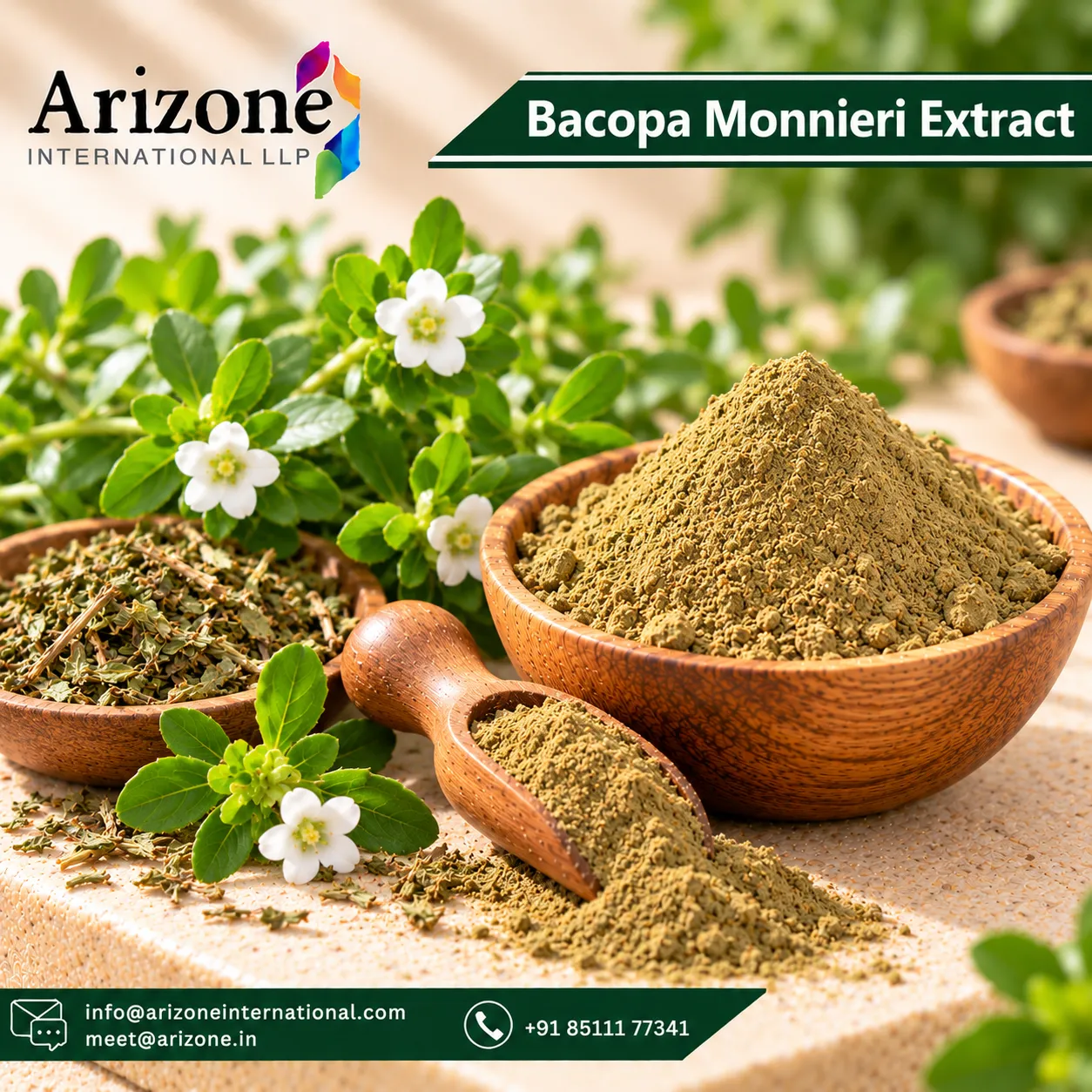
Bacopa, known in Ayurveda as brahmi, is one of the most popular botanicals in memory and focus formulas. It's also one of the easiest to overpay for. Two suppliers can both offer "50% bacosides" and ship powders with very different amounts of the compounds that matter, because one measured by UV and the other by HPLC. If you buy bacopa extract for supplements, the test method is the first thing to agree, not the last.
In short: 20% bacosides by HPLC is a realistic, widely used grade. Higher figures, especially 40–50% and above, are usually measured by UV, which picks up other compounds and reads high. Ask for bacosides by HPLC with the named marker peaks, and compare offers on the same method.
What bacosides are
Bacosides are triterpenoid saponins in Bacopa monnieri, a small creeping herb that grows in wet ground across India. The whole above-ground plant is harvested, dried and extracted, usually with water-ethanol. "Bacosides" isn't a single compound. When labs talk about "bacoside A", they normally mean a group of four main markers: bacoside A3, bacopaside II, bacopasaponin C and a jujubogenin isomer of bacopasaponin C. HPLC methods measure these peaks individually and add them up.
UV vs HPLC
| UV spectrophotometry | HPLC | |
|---|---|---|
| How it works | Measures how much light the whole sample absorbs at a set wavelength | Separates the individual saponins, then measures each against a reference standard |
| What it counts | Bacosides plus other compounds that absorb in the same range | Only the named bacoside markers |
| Typical results | High, often 40–55% claims | Lower, commonly around 20% for standard extracts |
| Best use | Quick in-process checks | Release testing and comparing suppliers |
Because UV doesn't separate anything first, it can't tell bacosides apart from other absorbing material in the extract. Suppliers who have retested high UV claims by chromatography report much lower figures. So a "50% by UV" offer at a low price isn't a bargain compared with "20% by HPLC". It may contain fewer bacosides.
Which grade should you buy?
- 20% bacosides by HPLC: a common, credible grade for capsules.
- Higher HPLC grades: available from some producers at a higher price, for smaller dose sizes.
- UV-specified grades: acceptable if that's what your formula and claims are built on, but don't compare them with HPLC offers.
- Whole-herb powder: for traditional-style products, brahmi powder is the simpler, lower-cost option.
Other quality points
- Identity: bacopa is sometimes confused in trade with Centella asiatica (gotu kola), which is also called brahmi in parts of India. An HPTLC or HPLC fingerprint settles it.
- Heavy metals: bacopa grows in wet, sometimes polluted ground and can take up metals, so lead, cadmium, arsenic and mercury should be reported as numbers by ICP-MS.
- Microbiology, pesticides and ethylene oxide (EU), as for any herb.
Our guide on identity testing and adulteration covers fingerprinting in more detail.
A specification you can copy
| Parameter | Example requirement |
|---|---|
| Botanical source | Bacopa monnieri (L.) Wettst., aerial parts |
| Assay | Total bacosides not less than 20%, by HPLC (sum of named markers) |
| Identity | HPTLC/HPLC fingerprint matches reference; distinguishes from Centella |
| Extraction solvent | Water-ethanol, with residual solvent results |
| Heavy metals | Pb, Cd, As, Hg by ICP-MS, to target-market limits |
| Other contaminants | Microbiology, pesticides, ethylene oxide (EU) |
For bacopa, "20% by HPLC" is a stronger promise than "50% by UV". Agree the method first, then talk price.
Bacopa from Arizone
Arizone International LLP supplies bacopa monnieri extract, brahmi powder and bacopa capsules to export customers, with a certificate of analysis for every batch. Tell us the bacoside level and the method you need, and we'll confirm the grade and send a sample COA.
Bacopa Extract Questions
Only if both are measured by the same method. Most 50% claims are measured by UV, which reads high; 20% by HPLC is a realistic standard grade.
Usually the bacoside A group: bacoside A3, bacopaside II, bacopasaponin C and a jujubogenin isomer of bacopasaponin C, added together.
Usually brahmi means Bacopa monnieri, but in some regions the name is also used for Centella asiatica. Always specify the botanical name and test identity.
Bacopa grows in wet ground and can absorb metals from soil and water, so lead, cadmium, arsenic and mercury should be measured on every batch.