
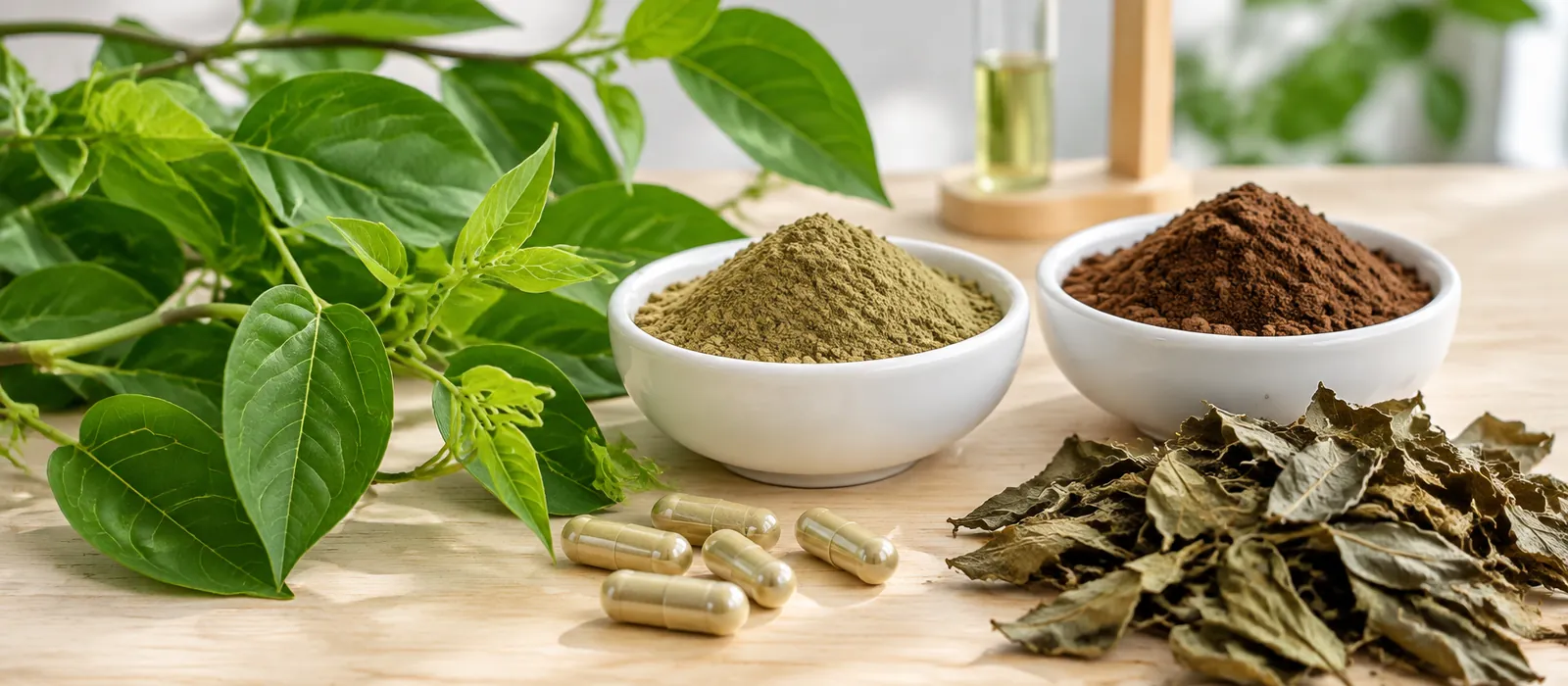
Photo: Unsplash
In Hindi, gymnema is called gurmar, "sugar destroyer", because chewing a leaf briefly blunts your ability to taste sweetness. That unusual effect has made Gymnema sylvestre a regular in blood sugar support formulas around the world. When you buy the extract, you'll be offered grades such as 25%, 45% and 75% gymnemic acids. The catch is that these numbers are usually measured by a method that can't tell you as much as you'd expect. Here's how to read them.
In short: most gymnema grades are measured gravimetrically, which weighs a crude acid fraction and gives high numbers. HPLC measures specific gymnemic acid markers and gives lower, more precise results. A "75%" gravimetric extract and a "25%" HPLC extract can't be compared directly. Ask which method was used, and compare suppliers only on the same one.
What gymnemic acids are
Gymnemic acids are a family of triterpene saponins found in gymnema leaves. There are many of them, with similar structures, which is why measuring "gymnemic acids" as a single number has always been tricky. The extract is made from dried leaves, usually with water or water-ethanol, then concentrated and dried to a fine brown to greenish powder with a bitter taste.
Gravimetric vs HPLC: the heart of the matter
| Gravimetric | HPLC | |
|---|---|---|
| How it works | The acid fraction is precipitated, dried and weighed | Individual marker compounds are separated and measured against a reference standard |
| What it measures | A crude total that includes other co-precipitating material | Specific gymnemic acid markers, often reported as deacyl gymnemic acid |
| Typical results | High: 25% to 75% grades are common | Lower numbers for the same material |
| Strengths | Quick, cheap, widely used in industry | More specific, accurate and reproducible |
Published comparisons support this picture: studies have found that gravimetric results for gymnemic acids are significantly higher than HPLC results for the same samples, and reviews describe gravimetry as suitable only for a crude total estimate. That's why a 75% gravimetric extract is not "three times stronger" than a 25% HPLC extract. They're answering different questions.
Which grade should you buy?
- 25% (gravimetric): an economical, widely used grade for capsules and blends.
- 75% (gravimetric): a more concentrated extract for smaller doses per capsule.
- HPLC-specified grades: chosen by brands that want a tighter, more defensible specification, or that are matching a published study's material.
Whichever you choose, keep the method fixed in your specification so every batch is measured the same way. Changing method between batches makes your own quality data meaningless.
Other quality points
- Identity: HPTLC or HPLC fingerprint against reference leaf; gymnema is sometimes confused with other leaves in trade.
- Plant part: leaf. Stems lower the quality.
- Carrier: some extracts include maltodextrin or other carriers to standardise or improve flow. That's fine if declared.
- Contaminants: heavy metals, microbes, pesticides and, for the EU, ethylene oxide, reported as numbers.
- Taste: bitter, and remember the sweet-taste-blocking effect if you plan chewables or drinks.
Claims and markets
Gymnema is usually positioned for blood sugar support. In the EU, botanical health claims are tightly restricted, and diabetes-related wording is a medicinal claim that foods can't make. In the USA, structure/function wording must avoid disease claims. Keep your label in line with your market; see EU health claims for botanicals.
A specification you can copy
| Parameter | Example requirement |
|---|---|
| Botanical source | Gymnema sylvestre (Retz.) R.Br. ex Sm., leaf |
| Assay | Gymnemic acids not less than 25% (or 75%), state method: gravimetric or HPLC |
| Identity | HPTLC/HPLC fingerprint matches reference |
| Extraction solvent | Water or water-ethanol, with residual solvent results |
| Physical | Mesh size, loss on drying, bulk density |
| Contaminants | Heavy metals, microbiology, pesticides, ethylene oxide (EU) |
Not sure whether a standardised extract or a ratio extract fits your formula better? See extract ratio vs standardised extract.
With gymnema, the method is part of the grade. "75%" without "gravimetric" or "HPLC" next to it isn't a specification.
Gymnema from Arizone
Arizone International LLP supplies gymnema sylvestre extract and gymnema capsules to export customers, with a certificate of analysis for every batch. Tell us the grade and the test method you work with, and we'll confirm the specification before you order.
Sources: Journal of Natural Remedies: estimation of gymnemic acids; Pharmacognosy Reviews: Gymnema sylvestre review.
Gymnema Extract Questions
Not necessarily. Most grades are measured gravimetrically, which gives a crude total. Only results measured by the same method can be compared.
HPLC is more specific and reproducible. Gravimetry is quick and common in industry but measures a broader acid fraction and reads higher.
The leaf. Specifications should name the leaf and include an identity test, since stems and other leaves lower quality.
Compounds in the leaf briefly interfere with sweet taste receptors on the tongue. It's worth remembering for chewables and drinks.