
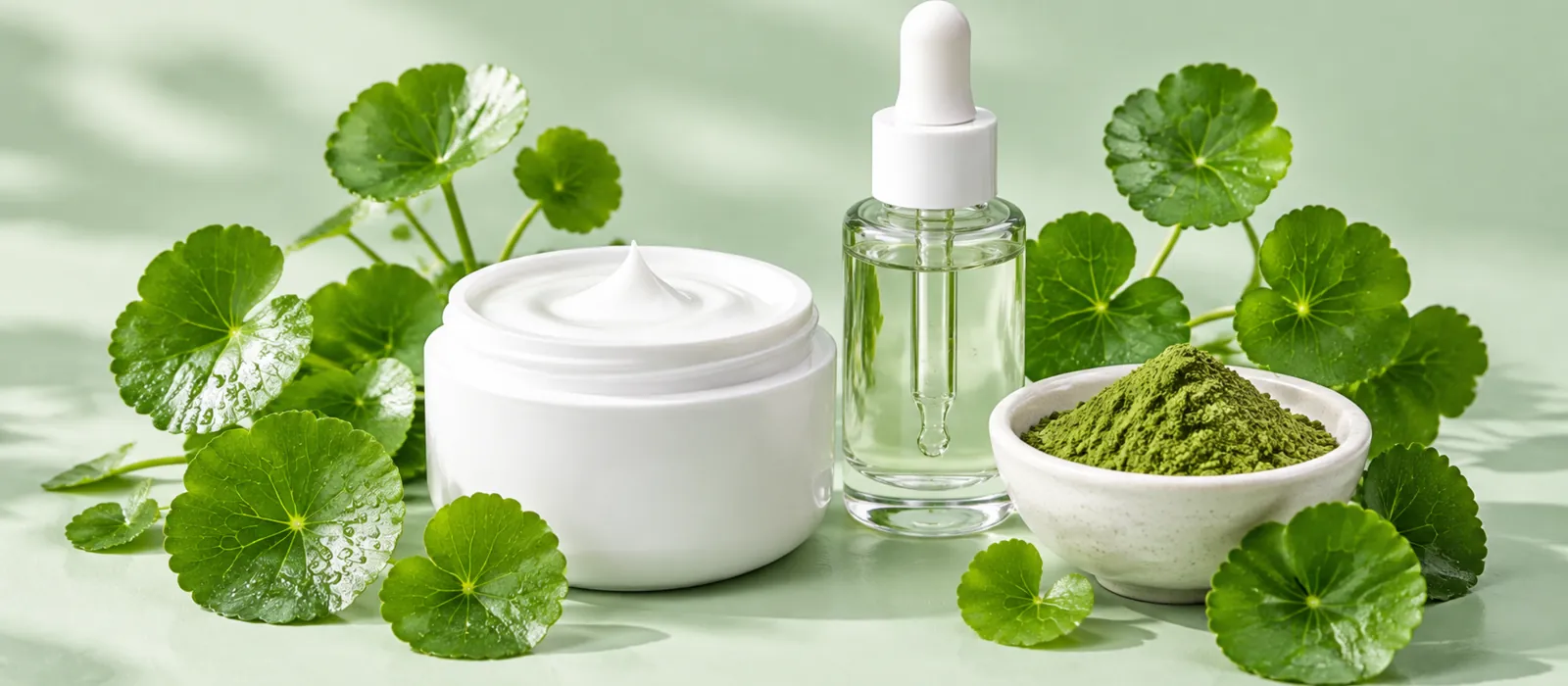
Photo: Unsplash
Centella asiatica, also called gotu kola, has two lives. In supplements it is a traditional Ayurvedic and Asian herb. In skin care it is "cica", one of the biggest ingredient trends to come out of Korean beauty, now in creams and serums across the US and Europe. Both markets buy the same plant, but on different specifications.
In short: Centella's value lies in four triterpenes: asiaticoside, madecassoside, asiatic acid and madecassic acid. Specify total triterpenes and the individual compounds by HPLC, confirm the species (it is often confused with bacopa, because both are called "brahmi"), and protect the extract from heat, light and high pH.
Key takeaways
- The four key triterpenes are two glycosides (asiaticoside, madecassoside) and two acids (asiatic, madecassic).
- Grades run from about 10% to over 90% total triterpenes, plus purified single compounds.
- In India "brahmi" can mean Centella asiatica or Bacopa monnieri; identity testing matters.
- Triterpene extracts are most stable as dry powders kept cool and away from light.
The four triterpenes
| Compound | Type | Notes |
|---|---|---|
| Madecassoside | Glycoside | Often the largest component; popular in cica skin care |
| Asiaticoside | Glycoside | The classic marker; pharmacopoeias express totals as asiaticoside |
| Madecassic acid | Aglycone (acid) | Formed from madecassoside when the sugar is removed |
| Asiatic acid | Aglycone (acid) | Formed from asiaticoside |
The ratio between them varies with plant part, harvest time and region, so two "40% triterpene" extracts can perform differently. Research extracts such as the Thai ECa 233 specify both a total (at least 80% triterpenoid glycosides) and a madecassoside-to-asiaticoside ratio. The European Pharmacopoeia's Centella monograph sets a minimum for total triterpenoid derivatives, expressed as asiaticoside.
Grades for supplements and cosmetics
| Grade | Typical use |
|---|---|
| Centella leaf powder | Traditional capsules and teas |
| Extract, 10–40% total triterpenes | Supplements; cosmetic creams |
| Extract, 70–95% total triterpenes ("TECA" type) | Premium cosmetics, serums |
| Madecassoside or asiaticoside, 90%+ | Targeted skin care actives |
| Glycerine or water-based liquid extract | Toners, essences, gels |
For cosmetics, also agree the INCI name (for example Centella Asiatica Extract, Centella Asiatica Leaf Extract, Madecassoside or Asiaticoside) so it matches your label. Our guide to choosing cosmetic botanical extract suppliers covers the paperwork.
Formulating with cica? Ask us for a triterpene profile by HPLC with your quote.
Request SpecsThe brahmi mix-up
In parts of India the name "brahmi" is used for both Centella asiatica and Bacopa monnieri, two quite different plants. Material sold under a common name can be the wrong species. Always buy on the Latin name and ask for:
- HPTLC or HPLC fingerprint showing the Centella triterpenes (bacopa contains bacosides instead).
- Macroscopic and microscopic identity on the raw herb.
- Heavy metals: Centella grows in wet, low-lying ground and can take up metals from soil and water.
See our bacopa extract guide for the other "brahmi".
Stability and formulation
Studies on standardised Centella extracts found them stable as dry powders kept cool and protected from light, but unstable at alkaline pH. In practice:
- Store powders sealed, cool and dark; re-test after long storage.
- Keep cosmetic formulas in a mildly acidic to neutral pH range.
- Purified acids (asiatic, madecassic) are poorly soluble in water; formulators often pre-dissolve them in glycols.
Rules by market
- EU and UK cosmetics: Centella ingredients are listed in the EU CosIng database; the product needs a safety assessment and the right INCI name. Wound-healing claims would make a product a medicine.
- EU food supplements: check the Novel Food status of the form you sell in your target country; no health claims are authorised.
- USA: cosmetic under MoCRA (facility registration and product listing); dietary supplement with structure and function claims only.
Buyer checklist
- Latin name Centella asiatica, plant part and origin
- Total triterpenes plus individual compounds by HPLC
- Identity fingerprint ruling out bacopa and other species
- Heavy metals, pesticides and microbiology
- Solvent, carrier and INCI name for cosmetics
- Storage conditions and re-test date
One plant, two markets: buy cica on its triterpene profile, not its trend.
Centella and Skin Care Botanicals
Centella asiatica extract, powder and capsules with other botanicals for supplement and cosmetic brands, with a COA for every batch.
Gotu Kola Extract
View Product
Centella Asiatica Capsules
View Product Gotu Kola Capsules
View ProductGotu Kola Powder
View ProductBacopa Monnieri Extract
View ProductAloe Vera Extract
View ProductCentella Asiatica from Arizone
Arizone International LLP supplies gotu kola extract and makes Centella asiatica capsules for brands outside India. Tell us your triterpene target, use (supplement or cosmetic) and market, and we'll confirm the specification.
Sources: Heliyon (2023): triterpenoid-rich Centella asiatica extract; Thai J Pharm Sci: standardised extract ECa 233; Natural Product Sciences: stability of a standardised Centella extract.
Centella Asiatica Questions
Yes. Gotu kola is a common name for Centella asiatica; in skin care it is often called cica.
Four triterpenes: asiaticoside, madecassoside, asiatic acid and madecassic acid.
In parts of India the name brahmi is used for both Centella asiatica and Bacopa monnieri, so always buy on the Latin name.
Titrated extract of Centella asiatica: a highly purified extract rich in total triterpenes, used mainly in skin care.
As a dry powder, sealed, cool and protected from light. Triterpenes are less stable at alkaline pH.