
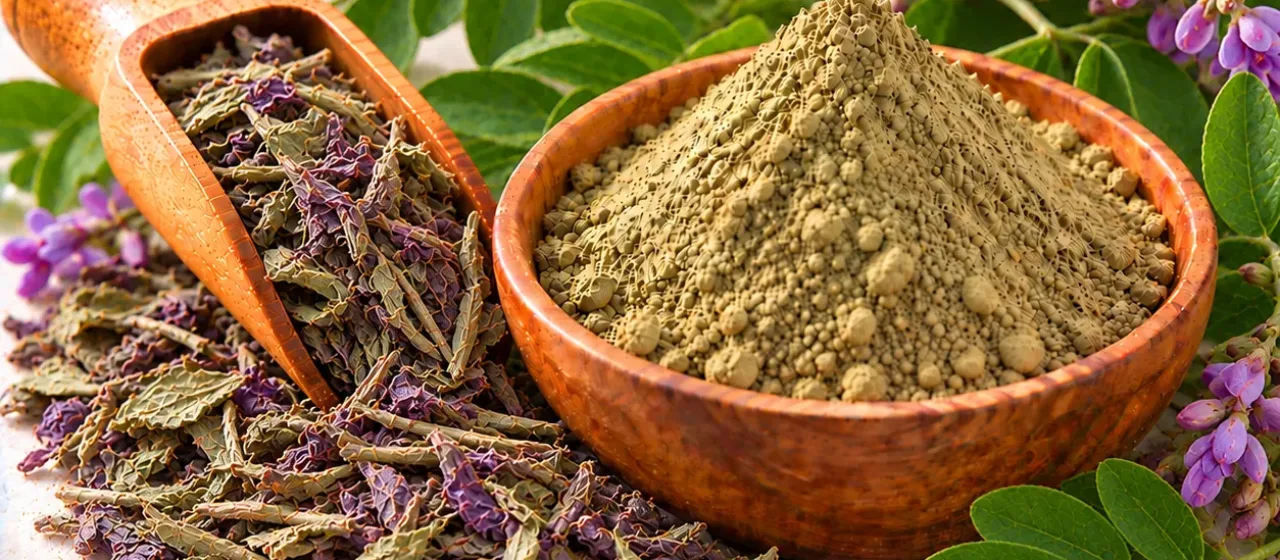
In short: indigo powder is the dried, milled leaf of Indigofera tinctoria. It is used as a plant-based hair colour, usually together with henna, to get brown and black shades without synthetic dyes such as PPD. Natural hair colour brands, salons and private label companies in Europe, North America and the Middle East buy bulk indigo powder and henna powder as base ingredients. This guide explains how indigo works, how it is used, and what to check before you buy.
What is indigo powder?
Indigo is a leafy shrub grown in India and other warm countries. Its leaves contain colourless compounds that turn into blue indigo dye when the leaf is crushed, moistened and exposed to air. For hair colour, the leaves are dried quickly and milled to a fine green powder, which keeps its colouring power. When people search for "indigo powder for hair", "Indigofera tinctoria leaf powder" or "natural indigo hair dye", they mean this material.
Why do brands use indigo powder for hair?
1. Plant-based hair colour
Indigo gives blue-black tones from a single plant ingredient. Consumers looking for natural or clean-label hair colour often prefer it to synthetic dyes.
2. An alternative to PPD-based dyes
Many people avoid PPD (para-phenylenediamine), a common synthetic dye ingredient. Pure indigo leaf powder contains no PPD. Our indigo and henna powders are PPD-free cosmetic grade. Because some products sold as "black henna" do contain PPD, buyers should always confirm this on the COA.
3. Works with henna for many shades
On its own, indigo gives a blue tint, especially on light or grey hair. Combined with henna, it creates shades from light brown to deep black, which is why most natural hair colour ranges sell both.
4. A traditional hair care ingredient
Indigo has long been used in traditional hair care in India and the Middle East, often in multi-herb hair powders with amla, bhringraj or shikakai.
5. Simple to formulate and pack
As a dry powder, indigo is easy to blend, fill into pouches or boxes, and ship. That keeps production simple for private label brands.
How are henna and indigo used together?
- Two-step method for black: henna is applied first and rinsed out, then indigo is applied over it. This gives the deepest black.
- One-step mix for brown: henna and indigo are mixed in different ratios. More henna gives warmer browns, and more indigo gives darker, cooler browns.
- Fresh mixing: indigo is mixed with water just before use, because it loses colour strength quickly once wet.
For your instructions leaflet, always advise a strand test and a skin patch test 48 hours before use, as most hair colour regulations and good practice require.
The most important specification for a hair colour brand is not price. It is colour strength, a fine and even mesh, and documented proof that the powder is free from PPD and other added dyes.
Indigo powder vs henna powder vs neutral henna
- Indigo powder gives blue-black tones and is used with henna for brown and black. See our bulk indigo powder.
- Henna powder (Lawsonia inermis) gives orange-red to auburn tones, and is used alone or as the first step before indigo. See our henna powder.
- Neutral henna (Senna italica, commonly traded as Cassia obovata) adds little or no colour and is used for hair conditioning products. See our neutral henna powder.
What to check when you buy indigo powder in bulk
- PPD-free and dye-free: ask for this to be stated on the COA.
- Colour strength: test a sample on hair before you approve a batch.
- Mesh size: a fine, even powder mixes smoothly and rinses out easily. Ours is 60 to 100 mesh, with custom mesh on request.
- Freshness: indigo loses strength with age and moisture, so check the production date and keep it sealed. Shelf life is 24 months in original sealed packing.
- Heavy metals and microbiology: tested against the cosmetic rules of your market.
- Packing: 20 to 25 kg lined bags for manufacturers, or smaller pouches for private label.
Regulations for indigo hair colour
Hair colour ingredients are regulated as cosmetics. In the EU and the UK, hair dye substances are controlled under cosmetics regulations, with specific conditions of use. In the USA, colour additives for hair are regulated by the FDA, and the rules for plant dyes are not the same as for synthetic dyes. Check the status of Indigofera tinctoria for your product and market with a regulatory consultant before launch.
Buying indigo powder from India
India is a traditional origin for both indigo and henna. Send us the product, mesh, quantity and destination country. We will send samples and a COA, quote on EXW, FOB, CIF or DAP terms, and ship by sea or air with a commercial invoice, packing list, COA and certificate of origin. Arizone International LLP supplies export customers only, in the USA, the UK, the EU, the Middle East, Australia and 40+ other countries.
Indigo Powder Questions
On its own, indigo gives a blue tint, especially on light or grey hair. For black, it is normally applied after henna in a two-step process.
Yes. Our indigo powder is PPD-free cosmetic grade, made from pure Indigofera tinctoria leaf.
Henna (Lawsonia inermis) gives orange-red to auburn tones, while indigo (Indigofera tinctoria) gives blue-black tones. Used together, they produce brown and black shades.
Yes. We supply indigo, henna and neutral henna powders in bulk bags, or in smaller pouches for private label brands.
24 months in original sealed packing, stored cool and dry. Indigo loses colour strength when exposed to moisture, so keep packs closed.