
Image: Freepik
Tribulus terrestris, known in India as gokshura or gokhru, is a staple of sports nutrition and men's wellness ranges in the US, UK and Europe. Labels range from "40% saponins" to "90% saponins" to "60% protodioscin", and those numbers cannot be compared directly.
In short: "saponins" is a broad total, usually measured by a non-specific method; protodioscin is one specific compound measured by HPLC. Decide which marker your brand needs, name the plant part and method, and compare suppliers on the same basis.
Key takeaways
- Total saponins (often 40–90%) and protodioscin (a single saponin) measure different things.
- Saponin results by UV or gravimetric methods can include non-saponin material.
- Studies show tribulus from different countries has very different saponin profiles.
- Ayurveda uses the fruit; many Western extracts use the aerial parts. Specify which.
What tribulus is
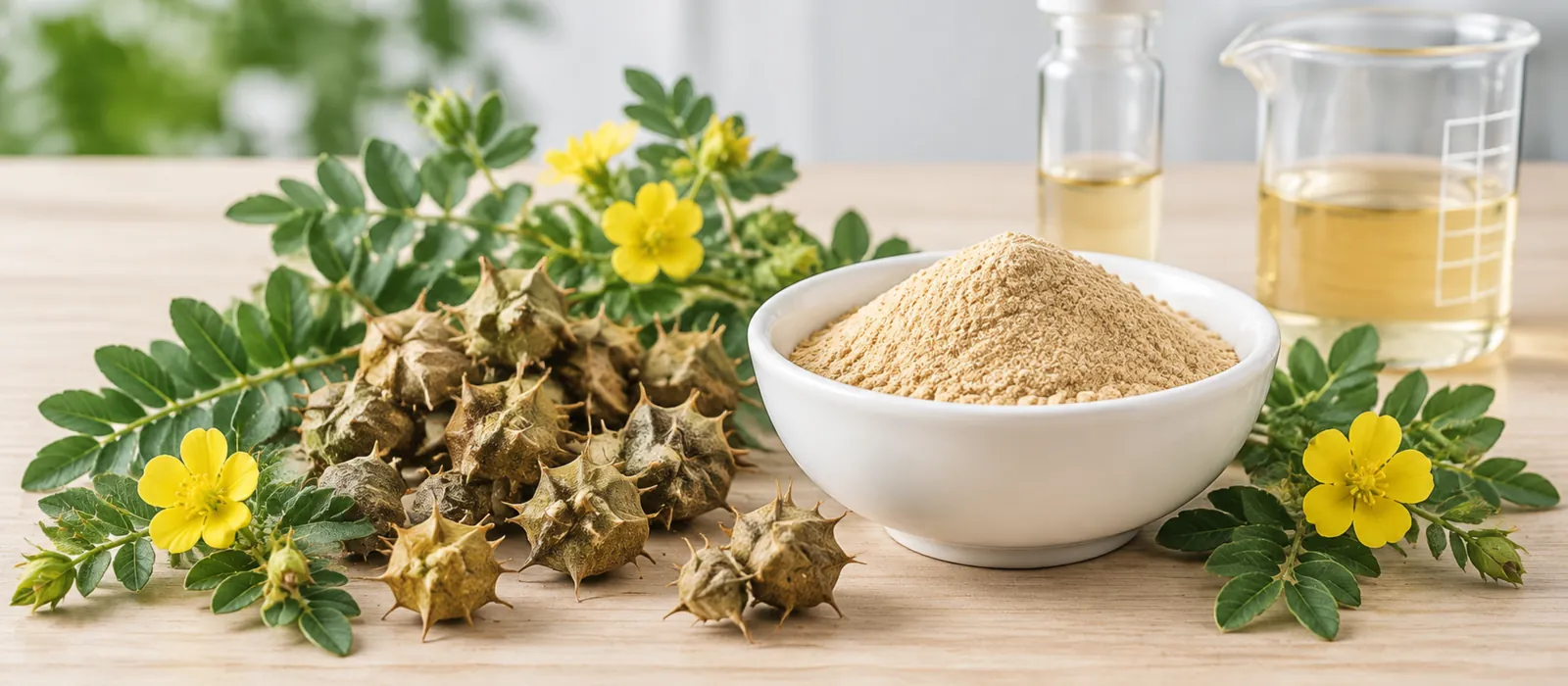
Tribulus terrestris is a low, spreading plant of warm, dry regions with spiny fruits (hence the names puncture vine and caltrop). It grows widely in India, the Balkans, Turkey and China. In Ayurveda the dried fruit, gokshura, is a long-established ingredient; in Europe the aerial parts became popular in sports supplements from the 1990s.
Its main constituents are steroidal saponins of the furostanol and spirostanol types, including protodioscin, prototribestin, dioscin and others, plus flavonoids.
Saponins vs protodioscin
| Label claim | What it measures | Typical method |
|---|---|---|
| 40%, 45%, 60% or 90% saponins | A group total of saponin-like compounds | UV colour reaction or gravimetric |
| Protodioscin, e.g. 20–45% | One specific furostanol saponin | HPLC or LC-MS against a reference standard |
| Extract ratio, e.g. 10:1 | Herb-to-extract weight ratio | Manufacturing record, not a test |
A "90% saponins" extract can contain less protodioscin than a "45% protodioscin" extract. Some European brands state explicitly that their protodioscin figure is not the same as total saponins. Our guide on extract ratios and standardisation explains why the method matters as much as the number. The same issue arises with fenugreek saponins.
Plant part and origin
Research comparing tribulus from Bulgaria, Turkey, Greece, India, China and other origins has found large differences in which saponins are present and in what amounts. Fruit and aerial parts also differ. For a buyer, this means:
- Name the plant part (fruit, aerial parts or whole plant) in the specification.
- Ask for the country of origin and keep it the same across orders.
- If your formula or claims are based on a study, match the study's plant part and marker.
Making tribulus capsules? Tell us your marker and we'll match the extract.
Request SpecsTesting tribulus
- Identity: HPTLC fingerprint and microscopy against tribulus reference material.
- Marker assay: protodioscin by HPLC or LC-MS if that is your claim; total saponins with the method stated if not.
- Contaminants: heavy metals, pesticides, microbiology and residual solvents per batch.
- Sports channel: brands selling to athletes often add batch testing under a sports certification programme to rule out contamination with prohibited substances.
See identity testing for herbal extracts for the general approach.
Rules by market
- USA: sold as a dietary supplement; structure and function claims only, with evidence held by the brand. Claims about hormone levels or sexual function attract FTC and FDA attention.
- EU and UK: sold as a food supplement in many countries; no health claims are authorised, and some national authorities restrict botanical claims further.
- Australia and Canada: regulated as listed complementary medicines or natural health products, with permitted indications and licensing.
Buyer checklist
- Botanical name, plant part and country of origin
- Marker named (total saponins or protodioscin) with the method
- HPTLC identity fingerprint
- Heavy metals, pesticides, microbiology and solvents
- Sports contamination testing if selling to athletes
- Claims checked for each market
"90% saponins" is a method result, not a quality grade. Ask what was measured and how.
Tribulus and Men's Wellness Capsules
Tribulus extract and capsules with other sports and men's wellness botanicals for private label brands, with a COA for every batch.
Tribulus Capsules
View ProductGokshura Extract
View Product Gokhru Capsules
View Product
Tongkat Ali Capsules
View Product
Safed Musli Capsules
View Product
Fenugreek Capsules
View ProductTribulus from Arizone
Arizone International LLP makes tribulus capsules and supplies gokshura extract for brands outside India. Tell us your marker, plant part and market, and we'll confirm the specification and testing.
Sources: Pharmacia: protodioscin in tribulus supplements by LC-MS/MS; Acta Biologica: constituents of Tribulus terrestris; Example label: protodioscin vs total saponins.
Tribulus Questions
Not necessarily. Total saponins is a broad group figure; protodioscin is one compound measured by HPLC, so the two can't be compared directly.
Yes. Gokshura or gokhru is the Ayurvedic name for Tribulus terrestris, traditionally the dried fruit.
Studies show tribulus from different countries has different saponin profiles, so keep origin and plant part consistent between orders.
By HPLC or LC-MS against a protodioscin reference standard.
In the US, structure and function claims with evidence; in the EU and UK, no health claims are authorised for tribulus.