
Image: Freepik
Shilajit has gone from an Ayurvedic niche to a social-media favourite in a few years, and the supply chain hasn't always kept up. Two jars of "pure Himalayan shilajit" can differ hugely in what's inside, and because it comes out of rock, contamination is a real concern, not a marketing scare. If you're buying shilajit resin, powder or extract in bulk for your own brand, here's how to judge quality with lab results rather than stories about mountain altitude.
In short: buy purified shilajit, not raw. Ask for fulvic acid content with the test method named, because methods give very different numbers. Insist on heavy metals reported as measured values by ICP-MS, plus microbiology and moisture. Ignore home "tests" like burning or dissolving; they can't tell you what's in it.
What shilajit actually is
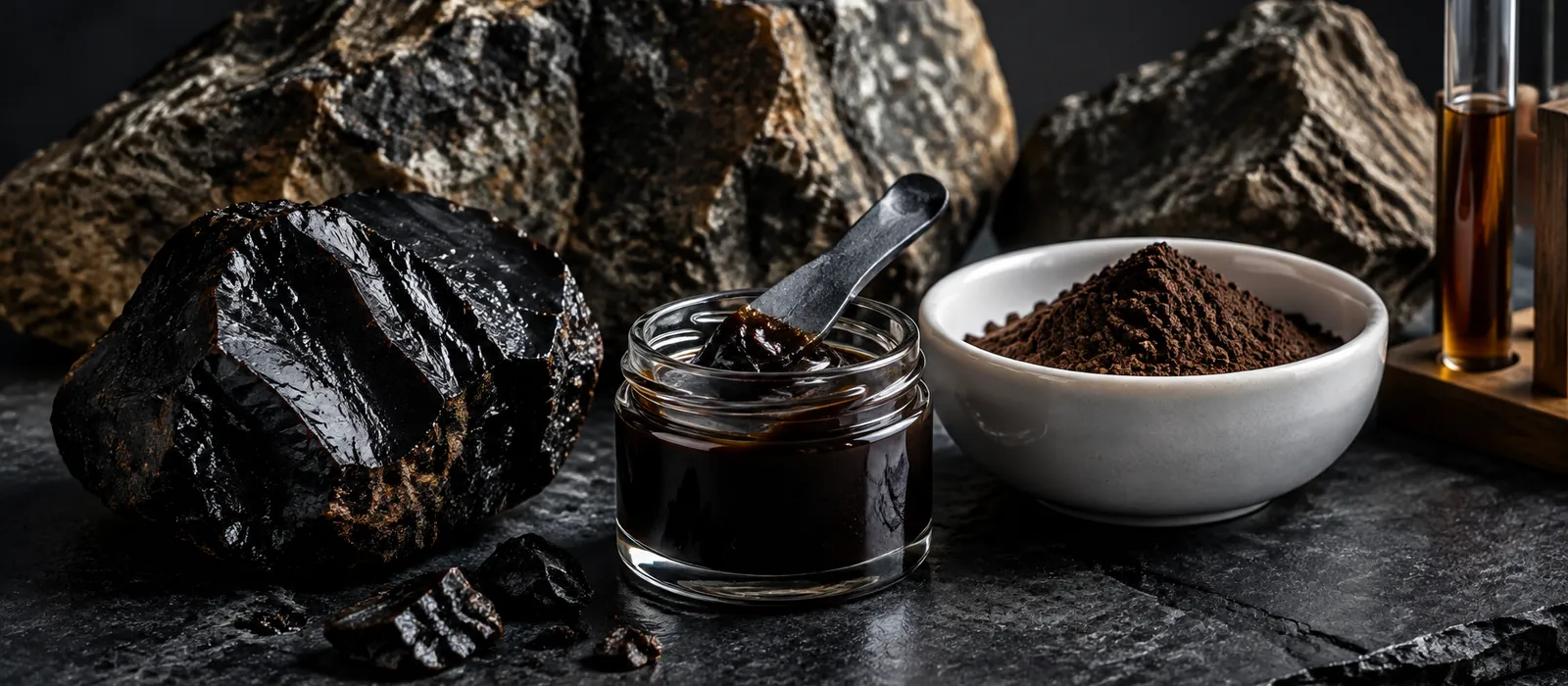
Shilajit is a dark brown to black, tar-like substance that seeps out of rock crevices in high mountain ranges, mainly the Himalayas, and in other ranges such as the Altai. It's formed over long periods from decomposed plant and microbial matter. Its main components are humic substances, especially fulvic acid, along with dibenzo-alpha-pyrones, small organic compounds and minerals.
It's sold in three main forms: purified resin, dried powder or extract, and capsules made from either. In Ayurveda it's always purified before use, and that step matters for safety as much as tradition.
Raw vs purified shilajit
Raw shilajit, as collected, contains rock particles, soil, plant debris and microbes. Purification usually means dissolving it in water, letting the insoluble matter settle, filtering, and concentrating the solution gently back into a resin, or drying it into a powder. Good purification lowers insoluble matter and microbial load, and gives a consistent product. Always ask the supplier how they purify, and whether the COA reports water-insoluble matter and ash.
Fulvic acid: the number everyone quotes
Fulvic acid content is the most common quality marker, and it's where comparisons go wrong. Different methods give very different results for the same sample. Some methods weigh an isolated fraction, others estimate fulvic content by titration or spectrophotometry, and they don't agree. So "60% fulvic acid" from one lab and "60% fulvic acid" from another aren't necessarily the same thing.
Independent testing shows how wide the range is. When ConsumerLab tested eight shilajit supplements in 2024, fulvic acid per serving ranged from about 7 mg to over 2,200 mg, and one product held far more than its label suggested, which points to label figures that don't match reality in either direction. For bulk buying:
- Ask for the fulvic acid percentage and the method on every batch COA.
- Compare suppliers only on the same method, ideally tested in the same lab.
- Be wary of very high figures with no method stated.
Heavy metals: the test you can't skip
Because shilajit forms in contact with rock, it can carry lead, arsenic, cadmium and mercury. Purification reduces insoluble mineral matter, but it doesn't guarantee low metals. The only way to know is testing every batch.
- Ask for lead, arsenic, cadmium and mercury as measured values, not "complies".
- The method should be ICP-MS, ideally from an ISO/IEC 17025 accredited lab for at least the first lots.
- Compare results with your market's limits and your daily dose. In the EU, food supplements must meet the maximum levels in Regulation (EU) 2023/915. In California, products may need a Proposition 65 warning depending on daily lead exposure.
Total arsenic can be tricky to interpret for natural materials; if it's elevated, ask whether speciation (inorganic vs organic arsenic) has been tested. Our guide to reading a certificate of analysis explains these results in more detail.
The full test list for bulk shilajit
| Test | Why it matters |
|---|---|
| Identity (HPTLC or FTIR fingerprint) | Confirms it matches genuine shilajit reference material |
| Fulvic acid, with method | The main quality marker; only comparable on the same method |
| Heavy metals by ICP-MS | Lead, arsenic, cadmium and mercury as numbers |
| Microbiology | Total plate count, yeast and mould, E. coli, Salmonella |
| Moisture / loss on drying | Affects stability, texture and dose accuracy |
| Water-insoluble matter and ash | Shows how well it was purified |
| pH and solubility | Useful for drinks, drops and consistent processing |
"Fake shilajit" and home tests
You'll find plenty of advice online about spotting fake shilajit: does it melt in your hand, burn without flame, dissolve fully in warm water? These checks may catch crude fakes, but they say nothing about metals, microbes or fulvic content, and a well-made fake can pass them. Trade reports describe dilution with fillers and blending with cheaper humic material from other sources. Published data on how common this is are limited, which is exactly why batch testing is the only reliable answer.
Red flags from a supplier
- No heavy metal numbers, or results that are years old
- A fulvic acid percentage with no method
- No explanation of how the material is purified
- Origin claims (altitude, region) offered in place of test data
- Reluctance to send a pre-shipment sample from the actual lot
With shilajit, the lab report is the product description. Everything else is packaging.
Shilajit from Arizone
Arizone International LLP supplies shilajit resin and shilajit capsules to export customers, with a certificate of analysis for each batch, made under ISO 22000:2018, GMP, FSSAI and HACCP. Tell us your market and daily dose, and we'll confirm the tests and limits for your order before dispatch.
Sources: ConsumerLab: shilajit supplements tested (2024); Regulation (EU) 2023/915 on contaminants; California OEHHA: Proposition 65.
Shilajit Questions
Use lab tests, not home tricks. An identity fingerprint, fulvic acid content with a named method, and heavy metals by ICP-MS on the batch COA tell you far more than melting or burning tests.
It can, because it forms in contact with rock. Purified, tested shilajit can be well within limits, but every batch should be tested for lead, arsenic, cadmium and mercury.
Labs use different methods, such as gravimetric, titration or spectrophotometric tests, which give different numbers for the same sample. Only compare results measured the same way.
Neither is better by default. Resin suits drops and traditional use; powder suits capsules and blends. Quality depends on purification and test results, not the form.