
Photo: Unsplash
Dried herbs and spices grow in fields, dry in the open air and pass through a lot of hands before they reach a factory. It's no surprise that many of them carry bacteria, yeasts and moulds, and sometimes Salmonella. So most bulk herbs and powders go through a step to bring that load down. How that's done matters more than many buyers realise, because the method that's routine in one country can get a shipment rejected in another.
In short: the three main options are steam treatment, ethylene oxide (ETO) and irradiation. Steam is accepted almost everywhere. ETO is banned for food use in the EU but permitted as a fumigant for spices in some countries, including the USA. Irradiation is allowed in both the EU and the USA, but only for certain products, and it must be declared. If you sell in Europe, ask for steam-treated or untreated material, plus an ETO test.
Why herbs need a microbial reduction step at all
Raw botanicals are agricultural products. Soil, dust, birds, insects and moisture during drying all add microbes. For a herb going into a cooked food, that may not matter much. For a powder going straight into capsules, teas or ready-to-mix drinks, it does, and buyers set limits for total plate count, yeast and mould, E. coli and Salmonella to match. When the natural load is too high, the material needs treating.
The three main methods, side by side
| Steam treatment | Ethylene oxide (ETO) | Irradiation | |
|---|---|---|---|
| How it works | Short exposure to saturated or superheated steam, then drying | A gas that kills microbes, used in sealed chambers | Gamma rays or electron beams pass through the product |
| Effectiveness | High, when the process is validated | High | High |
| Residues | None | Ethylene oxide and 2-chloroethanol can remain | None |
| Effect on quality | Can slightly reduce volatile oils or change colour if not well controlled | Little effect on flavour | Little effect at permitted doses |
| EU status | Accepted | Banned for food use | Only dried aromatic herbs, spices and vegetable seasonings, in approved facilities, labelled |
| USA status | Accepted | Permitted as a fumigant for spices within EPA tolerances | Permitted for spices and dried seasonings within FDA limits |
Steam: the method most buyers ask for
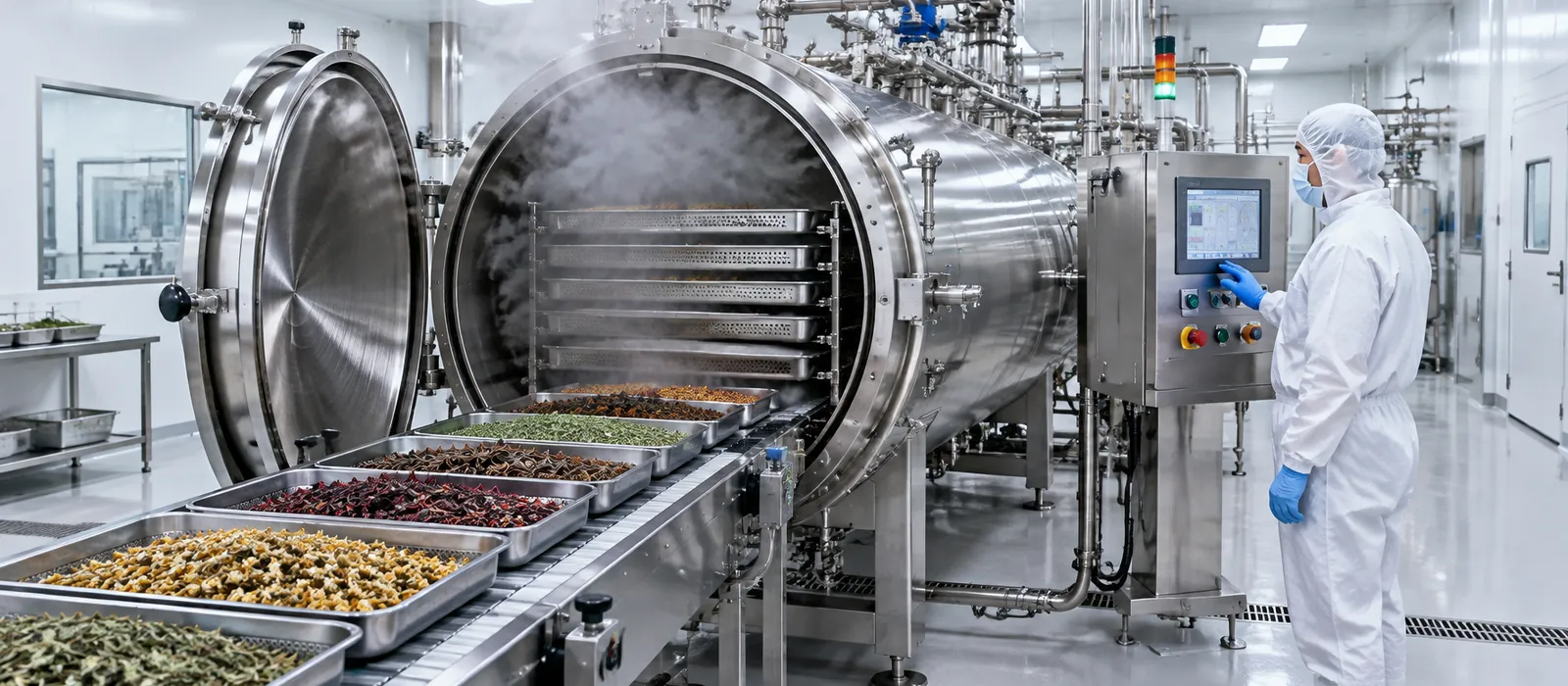
Steam treatment heats the herb's surface quickly with steam, holds it for a short, controlled time, then dries and cools it. Because it uses nothing but water and heat, it leaves no chemical residue and is accepted in practically every market, which is why European buyers tend to ask for it by name.
It isn't magic, though. Too much heat for too long can drive off some volatile oils, which matters for aromatic herbs, and can darken the colour slightly. A well-run process is validated: tested to show it reliably achieves the reduction it claims without damaging the product. It's reasonable to ask a supplier whether their steam process is validated and what microbial results it typically achieves.
Ethylene oxide: why it's a problem for Europe
ETO is very effective and cheap, and it barely touches flavour. The catch is that it can leave residues of ethylene oxide and 2-chloroethanol, and it's classed as a carcinogen. The EU banned its use on food decades ago. In 2020, ETO was found in sesame seeds from India, then in a long list of other foods and ingredients, and the result was one of the biggest recalls in European food history.
Since then, the EU has tested routinely. Food supplements containing botanicals from India are on the list for increased border checks for ethylene oxide. One positive result can mean a recall of every product made with that batch. That's why, for any EU order, you should ask for written confirmation that ETO isn't used, and a batch test for ethylene oxide plus 2-chloroethanol. Our EU import guide explains the border checks in detail.
In the USA, the picture is different. Ethylene oxide is permitted as a fumigant for spices, with residue tolerances set by the EPA. So material that's perfectly legal for one American customer may be unsellable in Europe. If you supply both markets, make sure your specification says which one each batch is for.
Irradiation: allowed, but declared
Irradiation passes ionising radiation through the product, which kills microbes without heat or residues. It's often misunderstood: it does not make food radioactive. In the EU it's permitted, but only for dried aromatic herbs, spices and vegetable seasonings, only in approved facilities, and the product must be labelled as irradiated. Herbal extracts aren't on that list. Many European buyers avoid irradiated material anyway, because their customers do.
In the USA, the FDA permits irradiation of spices and dried vegetable seasonings within set dose limits. Irradiated foods sold at retail generally carry the international Radura symbol and the words "treated with radiation" or "treated by irradiation".
What about extracts?
Extracts are a slightly different story. The extraction process itself, with hot water or alcohol, concentration and spray drying, usually reduces the microbial load a great deal. So for extracts, the bigger questions are hygiene after drying, packing in clean conditions and moisture control. Still, ask the same question: has any treatment been used, and which one?
The safest instruction for a mixed-market buyer is simple: "No ethylene oxide, no irradiation unless agreed in writing, steam treatment allowed and declared."
Newer options
Some processors also use radio-frequency or microwave heating, which warms the product from the inside, and ozone, which works mainly on surfaces. These can be useful for particular products, but they're less common. If a supplier offers them, ask for the same evidence you'd want for steam: validation data and microbial results.
Questions to ask your supplier
- Is this batch treated to reduce microbes, and by which method?
- Is the process validated, and what results does it typically achieve?
- Can you confirm in writing that ethylene oxide is not used?
- Has the batch been irradiated? If so, where, and is the facility approved for my market?
- What are the batch results for total plate count, yeast and mould, E. coli and Salmonella?
- For the EU: is there a batch test for ethylene oxide and 2-chloroethanol?
Then check the answers against the certificate of analysis. If you'd like a refresher on what each micro line means, see our guide on how to read a COA.
Ordering from Arizone
Arizone International LLP supplies herb powders, herbal extracts and capsules for export, with a certificate of analysis for every batch, under ISO 22000:2018, GMP, FSSAI and HACCP. When you enquire, tell us your destination market and your microbial and ethylene oxide requirements. We'll confirm the treatment, test results and documents available for your batch before shipment. We supply export customers only.
Sources: CBI: buyer requirements for herbs and spices in Europe; European Commission: food irradiation; US FDA: food irradiation.
Sterilisation Questions
No. Ethylene oxide is banned for use on food in the EU, and residues of ethylene oxide and 2-chloroethanol are tested for routinely, especially in herbs, spices and botanical supplements from India.
Yes, but only for dried aromatic herbs, spices and vegetable seasonings, in EU-approved facilities, and the product must be labelled as irradiated. Herbal extracts aren't on the permitted list.
A well-controlled, validated process has little effect, but too much heat for too long can reduce volatile oils and darken colour slightly, which matters most for aromatic herbs.
No. Irradiation passes energy through the product to kill microbes; it doesn't leave the food radioactive. In the EU and USA it is permitted for certain products within set limits and must be declared.
Written confirmation that ethylene oxide isn't used, the treatment method if any, microbial results, and a batch test for ethylene oxide plus 2-chloroethanol.