
Photo: Unsplash
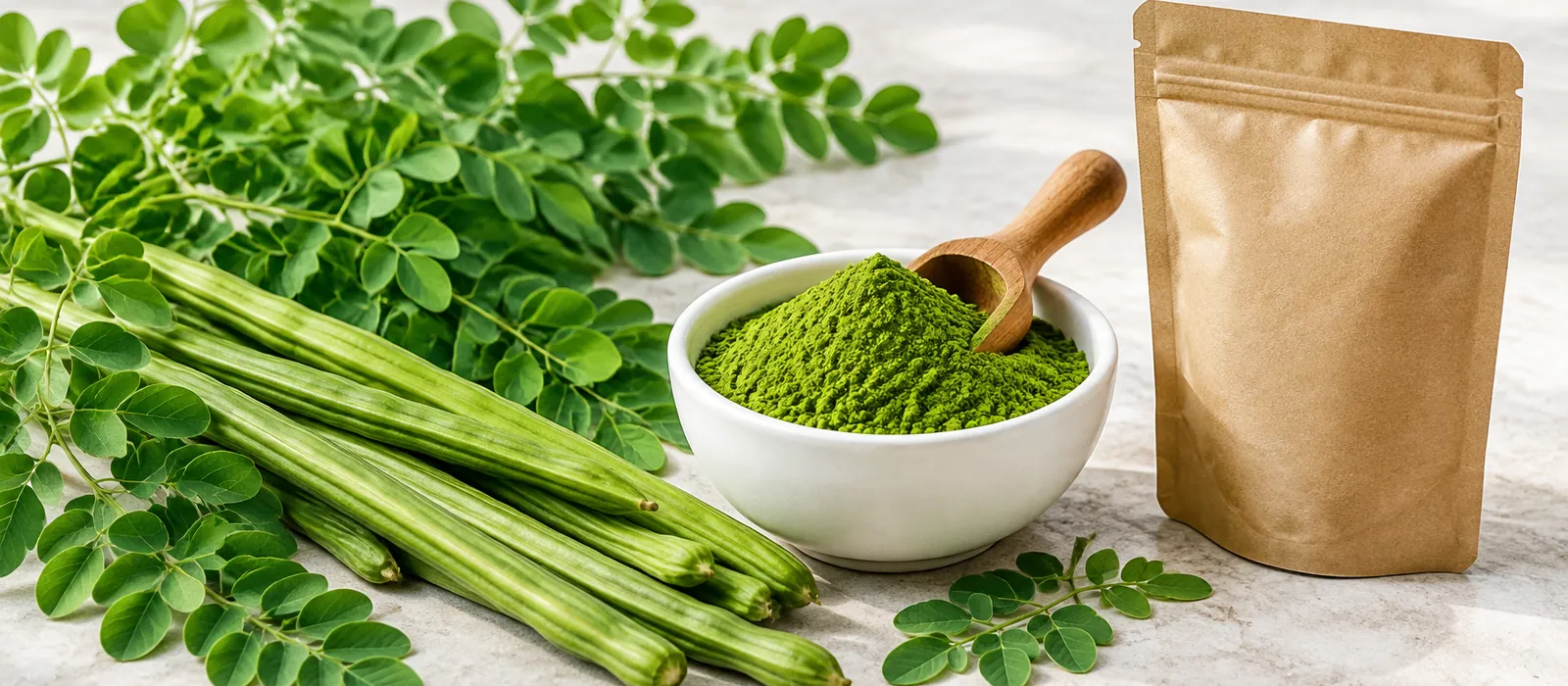
Moringa leaf powder looks like the simplest product in the botanical trade: dry the leaves, grind them, pack them. That simplicity is exactly what catches buyers out. Moringa is a leafy green that's eaten without cooking, and the way it's harvested, dried and handled decides whether you get a bright, clean powder or a dull one carrying microbes. The 2025 Salmonella recalls in the USA, traced to imported moringa leaf powder, made that very clear. Here's what to check before you buy moringa in bulk.
In short: look for leaf-only powder that has been dried at low temperature, with a fresh green colour, fine mesh, low moisture, and clean microbiology on every batch, including Salmonella absent in 25 g. Ask how the supplier controls microbes and whether they use a treatment step. Test pesticides, heavy metals and, for the EU, ethylene oxide.
Why microbiology comes first with moringa
Dried leaf powders are usually eaten without any cooking step: stirred into smoothies, encapsulated or sprinkled on food. Anything on the leaf at harvest or picked up during drying ends up in the customer's glass. Moringa is often dried in open air or simple driers, which makes good hygiene and controlled drying essential.
In October 2025, the US FDA and CDC investigated a multistate Salmonella outbreak linked to a lot of organic moringa leaf powder imported from India and used in a greens powder; further recalls and a reopened investigation followed into 2026. The lesson for every buyer, organic or not, is the same: a certificate saying "organic" says nothing about Salmonella. Only a batch test does.
Many buyers therefore ask for a validated microbial reduction step. For organic moringa, that's usually steam treatment, because ethylene oxide and irradiation aren't allowed. Steam can dull the colour slightly, which is a trade-off worth knowing about. We compare the options in steam sterilisation vs ETO vs irradiation.
Leaf only: stems change everything
Good moringa powder is made from leaflets stripped from the stalks. Leaving in stems and twigs adds bulk and fibre, lightens the colour and dilutes the leaf. It's a common way to cut cost. A higher stem content shows up as a paler, more yellowish powder with a woody taste. Ask for "leaf only" on the specification, and compare samples side by side: the difference is usually visible.
Drying and colour
Colour is a useful first check. Leaves dried in the shade or at controlled low temperatures keep a bright to dark green colour and a fresh, grassy smell. Leaves dried in hot sun or at high heat turn olive or brown, and lose some of the delicate compounds along with the colour. Colour alone doesn't prove quality, since an old or poorly stored powder fades too, but a brown "moringa" is rarely a good sign.
Mesh size and moisture
| Use | Typical mesh | Why |
|---|---|---|
| Capsules | 80–100 mesh | Fine powder flows and packs evenly |
| Smoothie and drink powders | 80–120 mesh | Mixes smoothly with less grit |
| Tea and infusions | Cut leaf, TBC grades | Leaf pieces brew better than fine powder |
| Food ingredients and blends | 60–80 mesh | Good balance of cost and texture |
Moisture should be low, commonly under about 8%, to keep the powder free-flowing and stable. Moringa is fairly hygroscopic, so packing with good liners matters. See our guide on shelf life and storage.
Contaminants to test
- Pesticides: a multi-residue screen against your market's limits. Moringa is often grown by small farmers, so traceability of the leaf matters.
- Ethylene oxide: essential for the EU, where it must not be detectable above strict limits.
- Heavy metals: lead, cadmium, arsenic and mercury as measured values; leafy crops can take up metals from soil and dust.
- Microbiology: total plate count, yeast and mould, E. coli, Salmonella, and often coliforms and Bacillus cereus.
A specification you can copy
| Parameter | Example requirement |
|---|---|
| Botanical source | Moringa oleifera Lam., leaf only |
| Appearance | Fine green powder, characteristic odour and taste |
| Particle size | Not less than 95% through 80 mesh (or as agreed) |
| Loss on drying | Not more than an agreed limit, e.g. 8% |
| Microbiology | Agreed TPC and yeast and mould limits; E. coli absent; Salmonella absent in 25 g |
| Contaminants | Pesticides, ethylene oxide and heavy metals to target-market limits |
| Microbial treatment | State method if used (e.g. steam) |
| Packing | 25 kg fibre drums or cartons with double food-grade PE liners |
Powder or extract?
Moringa leaf powder is the whole dried leaf, used as a green food ingredient. Moringa leaf extract is concentrated, usually with water or water-ethanol, and used where brands want a smaller dose or a defined extract ratio. If you're unsure which fits your product, our explainer on extract ratios helps.
With moringa, the colour gets your attention and the micro report earns your trust. Never approve a lot on looks alone.
Moringa from Arizone
Arizone International LLP supplies moringa leaf powder, moringa leaf extract and moringa capsules to export customers. Every batch comes with a certificate of analysis covering microbiology and contaminants, made under ISO 22000:2018, GMP, FSSAI and HACCP. Tell us your market, mesh and microbial limits, and we'll confirm the specification before dispatch.
Sources: US FDA: outbreak investigation of Salmonella, moringa leaf powder (October 2025).
Moringa Questions
A bright to dark green with a fresh, grassy smell. Olive or brown powder often means high-heat drying, stems in the mix, or old stock.
Moringa powder is eaten without cooking, so microbes on the leaf reach the consumer. Imported moringa leaf powder was linked to US Salmonella outbreaks in 2025, so every batch should be tested.
Yes. Organic certification covers farming and handling, not microbiology. Organic moringa should be tested batch by batch just like conventional powder.
Fine powder of about 80–100 mesh flows and packs evenly in capsule machines. Drink powders often use 80–120 mesh for a smoother mix.