
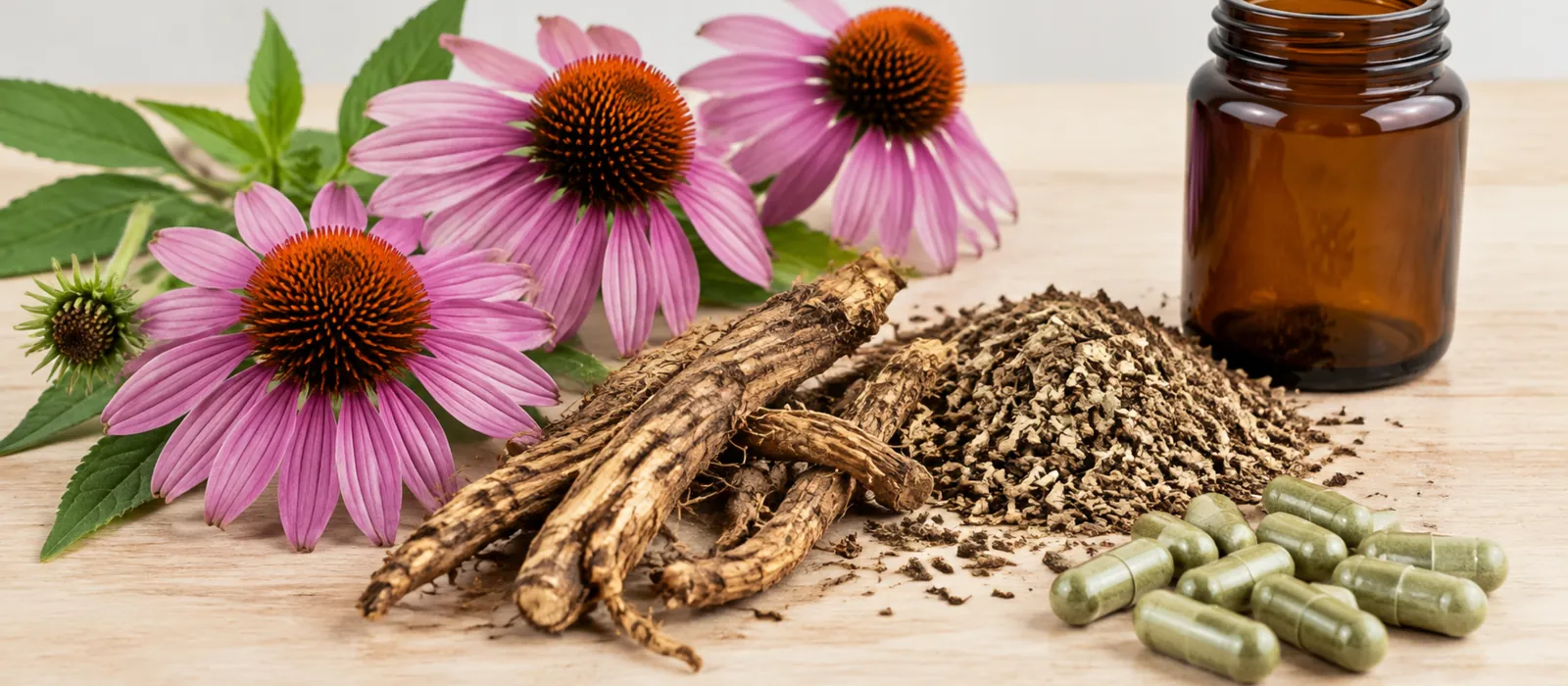
Image: Freepik
Echinacea, the purple coneflower, is a winter staple in pharmacies across the US, UK, Europe and Australia. It is also one of the more complicated herbs to buy, because three species and two plant parts are all sold as "echinacea", and they are not interchangeable.
In short: most products use Echinacea purpurea aerial parts or root, with E. angustifolia and E. pallida roots used less often. Quality is judged by markers such as alkamides and cichoric acid, and the species and plant part must be on the label.
Key takeaways
- Three species are used: Echinacea purpurea, E. angustifolia and E. pallida.
- Products use aerial parts (herb) or root, which have different chemical profiles.
- Alkamides and cichoric acid are common quality markers, measured by HPLC.
- People with allergies to the daisy family or autoimmune conditions should seek advice before use.
Species and plant parts
| Species | Parts used | Notes |
|---|---|---|
| Echinacea purpurea | Aerial parts and root | Most widely cultivated and used |
| Echinacea angustifolia | Root | More costly; wild supply limited |
| Echinacea pallida | Root | Used in some European products |
Historically, roots of other plants, such as Parthenium integrifolium, were sometimes sold as echinacea, which is why identity testing matters.
Alkamides and cichoric acid
Echinacea contains alkamides (responsible for the tingling on the tongue), caffeic acid derivatives such as cichoric acid and echinacoside, and polysaccharides. Different species and parts have different patterns; echinacoside, for example, is typical of angustifolia and pallida roots. Specifications usually state one or more markers by HPLC.
Powder, extract or juice
Capsules may contain dried herb or root powder, or a dry extract. In Europe, pressed juice from fresh E. purpurea herb is also common in liquid products. Choose the form to match your market and positioning, and state the species, part and form on the label.
Planning a winter range? Ask for our echinacea specification and sample COA.
Request SpecsTesting and adulteration
- Identity by HPTLC or HPLC, confirming species and part.
- Marker content: alkamides and/or cichoric acid.
- Heavy metals, pesticides and microbiology.
- Pyrrolizidine alkaloids are limited in EU herbal supplements, so ask for results where relevant.
See how to read a COA for what a complete certificate shows.
Rules and safety by market
- EU: the HMPC has EU herbal monographs on echinacea; products with medicinal indications are registered nationally, and supplements cannot make medicinal claims.
- UK: traditional herbal registrations exist for echinacea products.
- USA: dietary supplement with structure and function wording, such as supporting the immune system.
- Safety: not recommended for people allergic to the daisy family, and medical advice is suggested for people with autoimmune conditions or taking immunosuppressants.
Buyer checklist
- Species and plant part on the specification and label
- Marker content with method
- Identity test to rule out substitutes
- Contaminant results, including pyrrolizidine alkaloids for the EU
- Safety warnings suited to your market
Echinacea is three species and two plant parts. A good label tells customers exactly which one they are buying.
Echinacea and Seasonal Wellness Capsules
Echinacea and popular partners for winter wellness ranges, with a certificate of analysis for every batch.
Echinacea from Arizone
Arizone International LLP makes echinacea capsules for private label brands outside India. Tell us the species, plant part and market, and we'll confirm the specification and documents. Every batch ships with a certificate of analysis.
Sources: PMC: EMA monographs and herbal indications (2024); Regulation (EU) 2023/915 (pyrrolizidine alkaloid limits).
Echinacea Questions
Echinacea purpurea is the most widely used; E. angustifolia and E. pallida roots are also used. The right one depends on the product.
Both. Aerial parts and roots have different profiles, so the label should state which.
Compounds in echinacea that cause a tingling feeling on the tongue and are used as quality markers.
People allergic to the daisy family; people with autoimmune conditions should seek medical advice.
Products with medicinal claims are registered herbal medicines; supplements cannot make those claims.
By HPTLC or HPLC fingerprints that confirm species and plant part.