
In short: when you buy essential oils in bulk, check four things before you pay: the botanical name, the GC report, the COA and safety data sheet, and the packing and shipping method. Get these right and you avoid the two most common problems in the essential oil trade: diluted or adulterated oil, and shipments held up because the paperwork was wrong.
This guide is for soap, cosmetic, candle, aromatherapy and fragrance companies, and for distributors in the USA, the UK, Europe and Australia who are looking for an essential oil supplier for bulk orders.
Start with the botanical name, not the common name
"Lavender oil" can mean true lavender, lavandin or spike lavender. All three smell and perform differently, and they sell at very different prices. "Eucalyptus oil" can come from several species. Always put the Latin botanical name, the plant part and the extraction method (for example, steam-distilled leaves) on your purchase order. A good supplier will confirm all three on the specification sheet.
Ask about origin too. India produces many essential oils, such as mint, lemongrass, palmarosa, vetiver and ginger-family oils. Others, like tea tree oil from Australia, are sourced from their traditional growing regions. A transparent supplier tells you where each oil comes from.
Why the GC report matters most
Gas chromatography (GC) shows the chemical make-up of an oil, listing the main components and their percentages. It is the best everyday tool for spotting adulteration, such as an oil stretched with cheaper oils, synthetic compounds or carriers. For example, tea tree oil is usually judged on its terpinen-4-ol content, and peppermint oil on its menthol content.
Ask for a GC report for the batch you are buying, not a generic one. Compare it with a reference standard, such as the ISO standard for that oil where one exists, or with your own approved sample. Our step-by-step guide on how to read an essential oil GC-MS report shows what to look for.
A low price with no batch GC report is a warning sign. Genuine essential oils have real production costs, and a supplier selling genuine oil is happy to show the data.
Documents to ask for with every order
- Certificate of analysis (COA): appearance, odour, specific gravity, refractive index and optical rotation, checked against the specification.
- GC report: component breakdown for the batch.
- Safety data sheet (SDS/MSDS): needed for storage, workplace safety and transport.
- IFRA guidance: fragrance and cosmetic makers need it to set safe usage levels in finished products.
- Export documents: commercial invoice, packing list and certificate of origin.
How bulk essential oils are packed
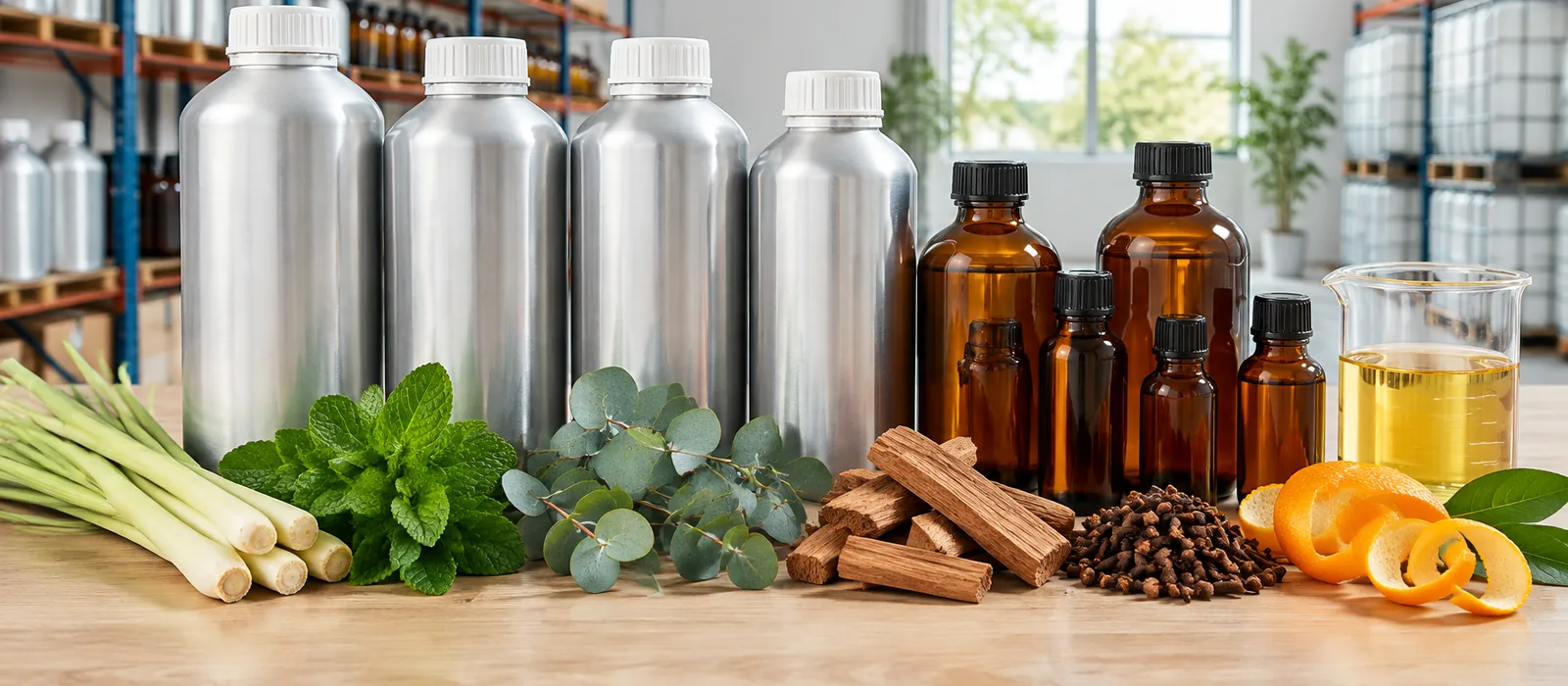
Essential oils are sensitive to light, heat and air, so packing matters. For export we use aluminium bottles (1 to 5 kg), HDPE cans (5 to 25 kg) and lacquered steel drums (up to 180 kg). Samples are sent in amber glass. Stored tightly closed in full containers, in a cool (below 25°C) dark place, our essential oils have a shelf life of 24 months in original sealed packing. If you plan to repack into small retail bottles, ask for smaller containers. Every time a large drum is opened, air gets in and the oil starts to age.
Shipping essential oils: sea or air?
Many essential oils are flammable and are classed as dangerous goods for transport. That affects how they can travel, especially by air, and it is one reason the safety data sheet must be correct. Drums and larger orders usually go by sea. Small or urgent orders can go by air or courier where the oil and quantity allow. We quote on EXW, FOB, CIF or DAP terms, so tell us your preferred Incoterm and destination port when you ask for a price.
Questions to ask an essential oil supplier
- What is the botanical name, plant part and origin of this oil?
- Can you send a batch GC report and COA with the sample?
- Is the oil 100% pure, or is it a blend or a diluted grade?
- What packing sizes are available for my order quantity?
- Will the supply be consistent from batch to batch, and from season to season?
Where to buy essential oils in bulk
Our essential oil range covers 150+ oils, including lavender oil, tea tree oil and peppermint oil, plus cold-pressed carrier oils for dilution and blending. Arizone International LLP supplies export customers only, in the USA, the UK, the EU, the Middle East, Australia and 40+ other countries.
Bulk Essential Oil Questions
Ask for a batch GC report and COA, and compare them with a reference standard or an approved sample. Smell and price alone are not reliable checks.
Aluminium bottles from 1 to 5 kg, HDPE cans from 5 to 25 kg and lacquered steel drums up to 180 kg. Samples come in amber glass.
Many essential oils are classed as dangerous goods, so air shipping depends on the oil and the quantity. Larger orders usually go by sea.
Our essential oils have a shelf life of 24 months in original sealed packing, stored tightly closed in a cool, dark place below 25°C.
No. We supply export customers only, in the USA, the UK, the EU, the Middle East, Australia and 40+ other countries.