
Photo: Unsplash
If you buy essential oils in bulk, sooner or later someone will send you a GC-MS report. It's usually a page of spiky peaks and a long table of chemical names with percentages next to them. It looks intimidating, but you don't need to be a chemist to get real value from it. You just need to know which few lines matter, and what the report can't tell you.
In short: a GC-MS report shows which aromatic compounds are in the oil and in what proportion. Check that the batch details match, compare the main compounds against a published reference range for that oil, look for compounds that shouldn't be there, and remember that GC-MS alone won't catch everything, especially dilution with fixed oils or clever synthetic additions.
What GC-MS actually does
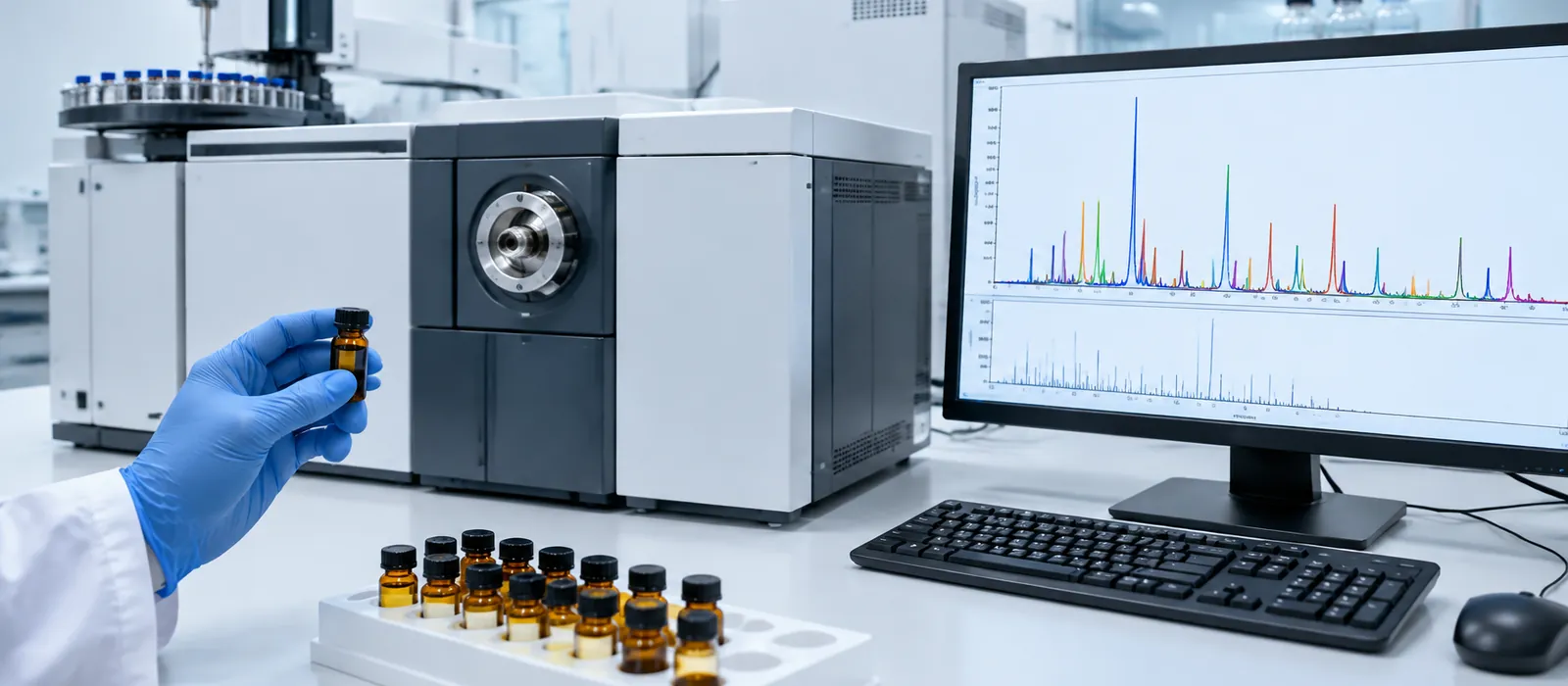
Gas chromatography (GC) heats a tiny sample and carries it through a long, thin column. Different compounds travel at different speeds, so they come out one after another. Mass spectrometry (MS) then identifies each one by breaking it into fragments and matching the pattern against a library. The result is a profile: a list of the volatile compounds in the oil and their relative amounts.
You'll sometimes see GC-FID mentioned as well. FID is a different detector that's better at measuring quantities, so many labs use GC-MS to identify the compounds and GC-FID to put accurate numbers on them.
The three parts of the report
1. The header
Check the oil's botanical name, the batch number, the date, and the lab. "Lavender oil" isn't enough: true lavender (Lavandula angustifolia), lavandin and spike lavender are different oils with different profiles and prices. The batch number should match the drum you're buying.
2. The chromatogram
This is the chart of peaks. Each peak is a compound; the taller the peak, the more of it there is. You don't need to read every peak. Just get a feel for whether the big ones are where you'd expect, and whether the chart looks clean or crowded with unexplained peaks.
3. The compound table
This is where the useful information sits. Each row gives the compound name, the retention time, and the percentage. Focus on the five to ten largest compounds, the ones that define the oil. For tea tree oil that means terpinen-4-ol; for peppermint, menthol and menthone; for lemongrass, citral (geranial and neral); for lavender, linalool and linalyl acetate.
What to compare it against
A GC-MS result only means something when you compare it with what that oil should look like. The best references are ISO standards, which exist for many common oils (ISO 4730 for tea tree oil is a well-known example), and pharmacopoeia monographs. Your own approved reference sample from a supplier you trust is useful too. If the main compounds sit comfortably inside the published ranges, that's a good sign.
| What you see | What it might mean |
|---|---|
| Main compounds inside reference ranges | Consistent with the genuine oil |
| A main compound far too high | Possible addition of that compound, or a different chemotype |
| Expected minor compounds missing | Possible blend of isolates or synthetics rather than a natural oil |
| Compounds that don't belong to that plant | Possible blending with a cheaper oil |
| Known synthetic markers | Strong sign of adulteration |
What GC-MS can miss
This is the part most buyers don't hear about. A standard GC-MS run is set up to look at volatile aromatic compounds. That leaves a few blind spots:
- Dilution with fixed oils. Vegetable oils and mineral oil don't evaporate like essential oils, so they may not show up at all. The percentages are relative to what was detected, so a 50% diluted oil can still look "normal".
- Nature-identical synthetics. A synthetic linalool is the same molecule as natural linalool, so ordinary GC-MS sees no difference.
- Area percent isn't weight percent. The numbers are relative peak areas. They're fine for comparing oils, but they aren't an exact weight-based measurement.
The extra tests that close the gaps
- Chiral GC separates mirror-image forms of the same molecule. Natural oils have characteristic ratios; for example, the linalool in true lavender is mostly one form. Synthetic versions are usually a 50:50 mix, so chiral analysis can reveal them.
- Physical tests, including specific gravity, refractive index and optical rotation, are cheap and quick, and a value outside the expected range is an early warning, including for dilution.
- Isotope ratio analysis (IRMS) can distinguish natural from petrochemical origin for high-value oils. It's specialised and more expensive, so it's usually saved for oils with a known fraud risk.
- Simple checks such as an evaporation test or a residue check can flag non-volatile diluents.
Think of GC-MS as the identity card of an essential oil. It's essential, but for expensive oils it's worth checking a second form of ID as well.
A quick checklist for every new oil
- Botanical name, plant part and country of origin on the report
- Batch number and date that match your drum
- Main compounds inside the ISO, pharmacopoeia or agreed reference range
- No unexpected or synthetic compounds
- Specific gravity, refractive index and optical rotation within range
- Chiral GC for oils where synthetic additions are a known risk
- A COA, an SDS (safety data sheet) and, for food use, the right food-grade documents
For the commercial side of buying oils in bulk, from drums and documents to shipping, see our guide to buying bulk essential oils from India.
Our essential oils
Arizone International LLP supplies essential oils such as lemongrass, tea tree, peppermint and lavender, as well as carrier oils. Tell us the oil, the grade and the tests your market needs, and we'll confirm the GC report and documents available for your batch. We supply export customers only, in the EU, the UK, the USA, the Middle East, Australia and 40+ other countries.
GC-MS Questions
It lists the volatile compounds in the oil and their relative amounts, so you can compare the oil's chemical profile with what that species should look like.
Not always. Fixed oils such as vegetable or mineral oil may not show up in a standard run, and the percentages are relative, so physical tests such as specific gravity and refractive index are a useful extra check.
Chiral gas chromatography separates mirror-image forms of the same molecule. Natural oils have typical ratios, so it can reveal synthetic additions that ordinary GC-MS can't.
ISO standards for the oil where one exists, pharmacopoeia monographs, or an approved reference sample. The main compounds should fall within the published ranges.
GC-MS identifies compounds by their mass spectra; GC-FID is better at measuring quantities. Many labs use both: GC-MS to identify and GC-FID to quantify.