
Image: Freepik
Most of the "cinnamon" sold in supermarkets in the USA and much of Europe isn't true cinnamon at all. It's cassia, a close relative with a stronger, spicier taste and a much higher level of a natural compound called coumarin. For a jar of spice used now and then, that difference rarely matters. For a daily supplement, a cinnamon tea or a product made for regular use, it matters a lot. Here's how the two compare and how to choose.
In short: Ceylon cinnamon (Cinnamomum verum) contains only traces of coumarin; cassia (Cinnamomum cassia and related species) can contain a great deal. If your product will be taken every day or in larger amounts, Ceylon is the safer choice. Whichever you buy, ask for the botanical species on the specification and a coumarin result on the COA.
Two different plants
| Ceylon ("true") cinnamon | Cassia cinnamon | |
|---|---|---|
| Botanical name | Cinnamomum verum (syn. C. zeylanicum) | C. cassia, also C. burmannii and C. loureiroi |
| Main origins | Sri Lanka, southern India | China, Indonesia, Vietnam |
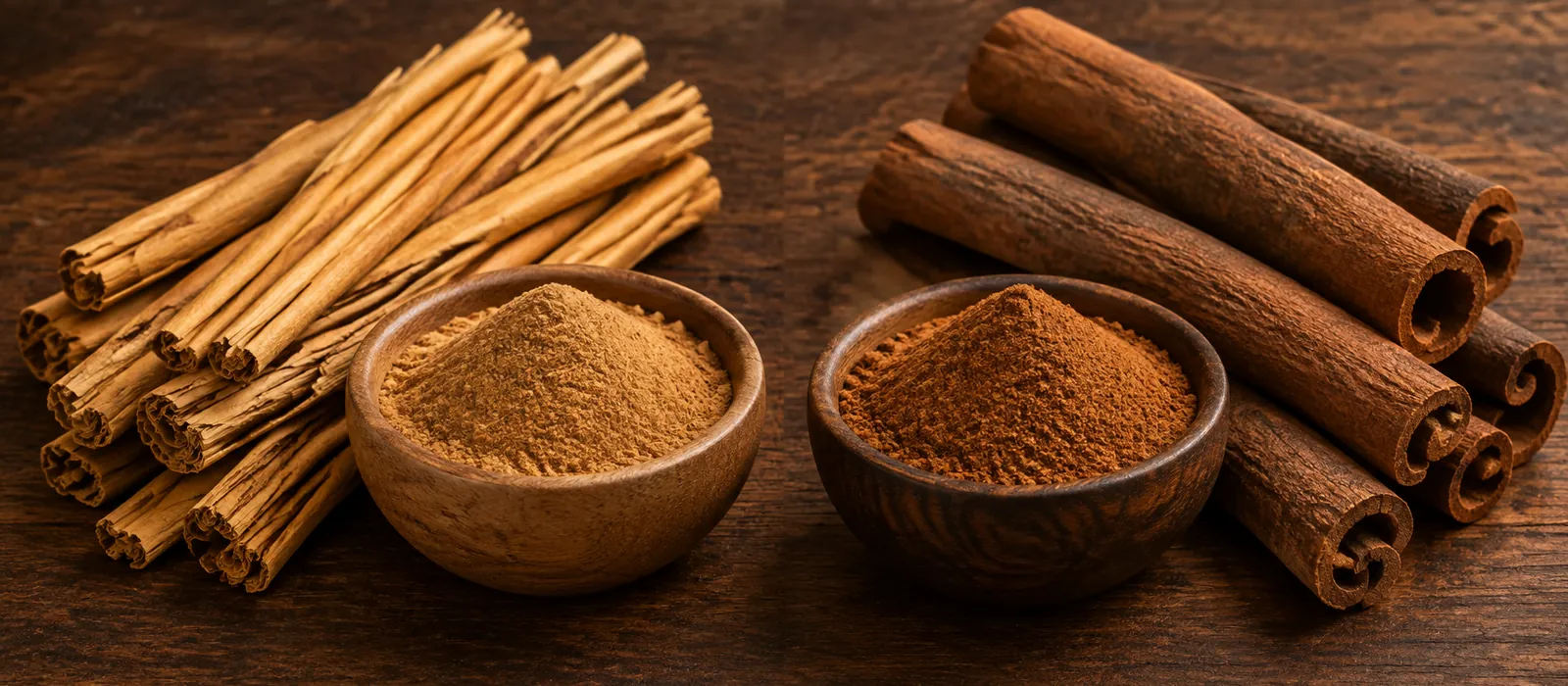
| Quills | Thin, papery layers rolled like a cigar | Thick, hard, single curl |
| Flavour | Mild, sweet, delicate | Strong, hot, spicy |
| Coumarin | Traces | Can be high and variable |
| Price | Higher | Lower |
Once ground, the two are hard to tell apart by eye, which is exactly why the species should be stated and checked.
Why coumarin matters
Coumarin is a naturally occurring flavour compound. In large amounts taken regularly, it can harm the liver in sensitive people. The European Food Safety Authority set a tolerable daily intake of 0.1 mg of coumarin per kilogram of body weight, which works out to about 7 mg a day for a 70 kg adult. Germany's Federal Institute for Risk Assessment (BfR) has advised that because cassia can contain a lot of coumarin, large amounts eaten over long periods aren't advisable, while Ceylon cinnamon's low coumarin content isn't a concern.
The problem is variability. Coumarin in cassia differs widely between origins, harvests and even individual pieces of bark, so a teaspoon of one batch can be very different from a teaspoon of another. For a capsule taken twice a day, that uncertainty is hard to defend.
EU limits
EU flavouring rules (Regulation (EC) No 1334/2008) set maximum coumarin levels in certain foods made with cinnamon, for example 50 mg/kg in traditional and seasonal bakery products that mention cinnamon on the label, 20 mg/kg in breakfast cereals, 15 mg/kg in other fine bakery wares and 5 mg/kg in desserts. These limits apply to the finished foods, not to cinnamon sold as a spice, but they explain why European bakers and cereal makers often specify low-coumarin cinnamon. For supplements, brands rely on the EFSA intake guidance and their own safety assessment.
Which should you buy?
- Daily supplements, capsules and wellness teas: Ceylon cinnamon or a low-coumarin specification.
- Bakery and cereals for the EU: low-coumarin cinnamon, so the finished product stays under the limits.
- Occasional seasoning and cost-led blends: cassia is common and acceptable, with coumarin known.
- Essential oils: cinnamon bark oil and cinnamon leaf oil are different products, with cinnamaldehyde dominating the bark oil and eugenol the leaf oil. Choose for the use.
What to put on the specification
| Parameter | Example requirement |
|---|---|
| Botanical source | Cinnamomum verum J. Presl, bark (or as agreed) |
| Coumarin | Not more than an agreed mg/kg, by HPLC |
| Identity | HPTLC/HPLC profile confirming species |
| Volatile oil | Not less than an agreed % for spice grades |
| Contaminants | Heavy metals, microbiology, pesticides, ethylene oxide (EU) |
See our guide on identity testing for how species are confirmed.
For an occasional sprinkle, cassia is fine. For something taken every day, choose Ceylon, and ask for the coumarin number either way.
Cinnamon from Arizone
Arizone International LLP supplies Ceylon cinnamon capsules, cinnamon extract, cinnamon bark oil and cinnamon leaf oil to export customers. Tell us the species and coumarin limit your product needs, and we'll confirm the specification and test results before you order.
Sources: BfR: FAQ on coumarin in cinnamon and other foods; Regulation (EC) No 1334/2008 on flavourings.
Cinnamon Questions
They come from different species. Ceylon is milder, sweeter and very low in coumarin; cassia is stronger, cheaper and can contain much more coumarin.
In normal food amounts, yes for most people. Germany's BfR advises against large amounts over long periods because of its coumarin content.
EFSA's tolerable daily intake is 0.1 mg per kg of body weight, about 7 mg a day for a 70 kg adult.
Ceylon cinnamon or a low-coumarin specification, with the species and a coumarin result stated on the COA.