
Photo: Unsplash
Boswellia is one of those ingredients where the label number can mislead almost everyone, including the brand selling it. One supplier offers "65% boswellic acids", another offers "30% AKBA", and the first looks twice as strong. It usually isn't. The two numbers measure different things, often with different test methods. If you buy Boswellia extract for supplements or functional products, it pays to know what's behind each figure before you compare prices.
In short: "65% boswellic acids" is a total for a whole family of resin acids, often measured by titration or UV. "30% AKBA" is the amount of one specific compound, acetyl-11-keto-beta-boswellic acid, measured by HPLC. A product can contain a lot of total boswellic acids and very little AKBA. Decide which marker matters for your product, then specify it with a named HPLC method.
Where Boswellia extract comes from
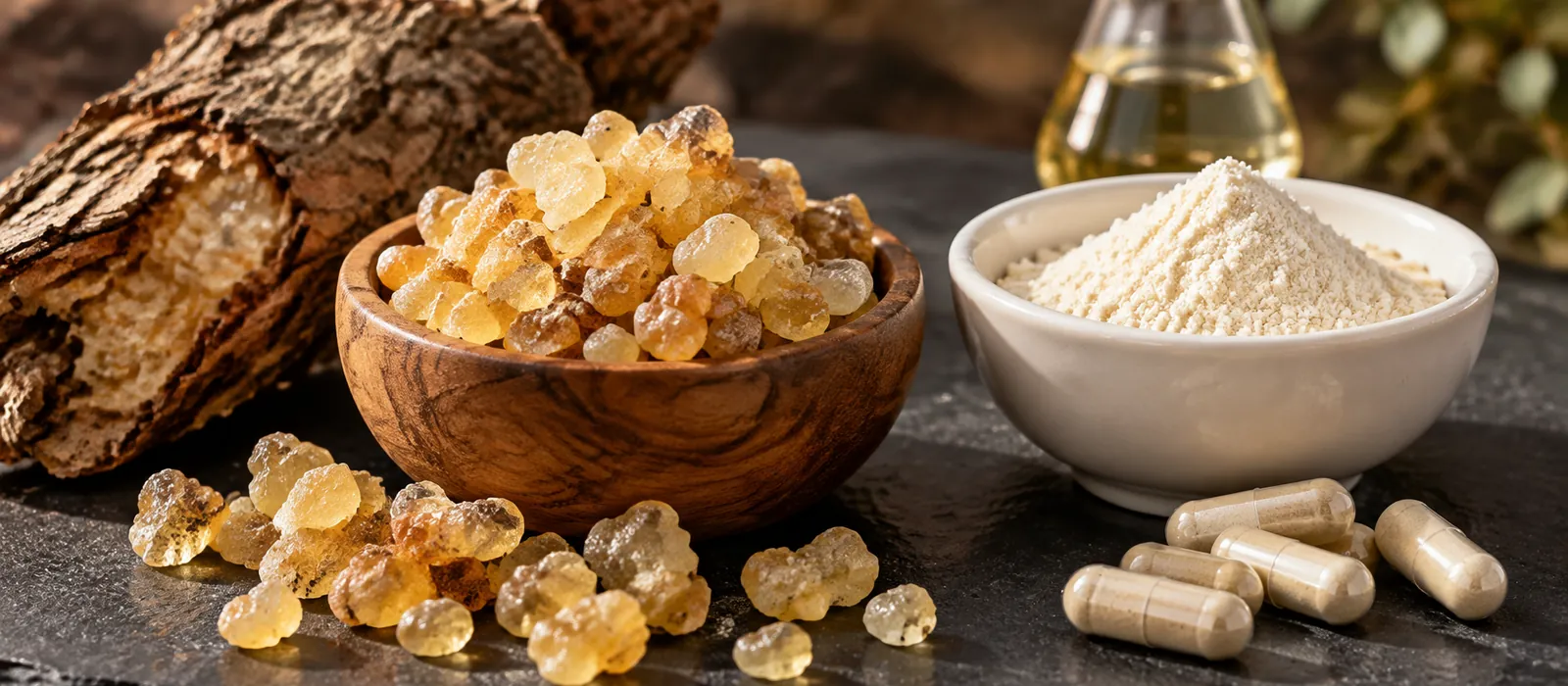
Boswellia extract is made from the gum resin of Boswellia serrata, the Indian frankincense tree, which grows in the dry hills of central and western India. Tappers cut the bark, the resin oozes out and hardens, and it's collected, cleaned and extracted, usually with ethanol. The resin contains a mix of pentacyclic triterpene acids known as boswellic acids, along with gums and essential oil.
There are several boswellic acids. The ones you'll see named on specifications are beta-boswellic acid, acetyl-beta-boswellic acid, 11-keto-beta-boswellic acid (KBA) and acetyl-11-keto-beta-boswellic acid (AKBA). KBA and AKBA are the ones most often studied, and they're present in much smaller amounts than the total.
"65% boswellic acids" vs "30% AKBA"
| Total boswellic acids (e.g. 65%) | AKBA (e.g. 10%, 20%, 30%) | |
|---|---|---|
| What it measures | The whole group of resin acids together | One specific acid, AKBA |
| Typical test | Titration (acid value) or UV; sometimes HPLC | HPLC against an AKBA reference standard |
| What a high number tells you | The extract is rich in resin acids overall | The extract is enriched in AKBA specifically |
| What it doesn't tell you | How much AKBA or KBA is present | The total acid profile, unless also reported |
| Relative cost | Lower | Higher, rising steeply with AKBA % |
So a 65% total-acid extract might contain only a few percent AKBA, and a 30% AKBA extract is a much more processed, enriched product. Neither is "better" in the abstract. They're different ingredients for different formulas and budgets.
Why the test method changes the answer
Titration measures acidity. It counts anything acidic in the sample, which includes boswellic acids but can also pick up other acidic compounds, so it tends to give generous totals. UV methods measure absorbance at a wavelength and are also broad. HPLC separates the individual acids and measures each one against a reference standard, so it's the method that tells you what's actually there.
This matters most when you're comparing quotes. A "65% by titration" extract and a "65% by HPLC" extract are not the same product, and published analytical work has found that some very high label figures for boswellic acids are unrealistic or based on unsuitable methods. If a supplier can't tell you the method, ask. If they won't, move on. Our guide on how to read a COA explains why the method line matters for every standardised extract.
Which one should you buy?
- Total boswellic acids (often 65%): a common, cost-effective choice for general joint-support and traditional formulas, powders and blends where the whole-resin profile is the point.
- AKBA-enriched extracts: chosen by brands that want to state a defined AKBA content per serving, or that are matching a specification used in published studies. Expect to pay more, and expect a smaller dose per capsule.
- Both reported: the most useful specification lists total boswellic acids and AKBA (and often KBA) separately, all by HPLC. Then you know exactly what you're getting.
Whatever you choose, keep claims in line with your market's rules. In the EU, for example, health claims for botanicals are tightly restricted; we cover that in EU health claims for botanicals.
Other things to put on the specification
- Botanical source: Boswellia serrata Roxb., oleo-gum resin. Other species, such as Boswellia carterii or B. sacra, have different acid profiles.
- Solvent: usually ethanol; ask for residual solvent results.
- Carrier or excipient: some extracts are adjusted with maltodextrin or silica to flow better. That's fine if it's declared.
- Physical: colour (off-white to light brown), mesh size, bulk density and loss on drying.
- Contaminants: heavy metals, microbiology, pesticides, and for the EU ethylene oxide, all reported as numbers.
Red flags when buying Boswellia extract
- Very high totals (70% and above) with no method stated
- "AKBA" mentioned on the label but no AKBA figure on the COA
- A price that looks like a 65% total-acid extract for a "30% AKBA" grade
- No botanical name, or a different Boswellia species than the one you asked for
Ask for the marker you care about, by name, by HPLC. "Boswellic acids 65%" on its own answers a different question.
Boswellia from Arizone
Arizone International LLP supplies Boswellia serrata extract, Boswellia powder and Boswellia capsules for export customers, with a certificate of analysis for every batch. Tell us the marker and level you need, total boswellic acids, AKBA or both, and we'll confirm the grade, the test method and a sample before you order.
Sources: Analytical study of boswellic acids in Boswellia products (PMC).
Boswellia Extract Questions
Not necessarily. 65% is a total for the whole group of boswellic acids, while 30% AKBA is the amount of one specific acid. A 65% extract can contain only a small amount of AKBA.
AKBA is acetyl-11-keto-beta-boswellic acid, one of the boswellic acids in Boswellia serrata resin. It's present in small amounts naturally and can be concentrated in enriched extracts.
HPLC against reference standards is the method that measures individual acids such as AKBA and KBA. Titration and UV give broader totals that aren't directly comparable.
Yes, and it's the most useful specification. Ask for total boswellic acids, AKBA and KBA reported separately, all by HPLC.