
Short answer: buy bulk ashwagandha root powder or standardised extract if you make your own capsules, tablets, gummies or drink mixes. Buy finished private label ashwagandha capsules if you want a ready product with your label on it and no production of your own. Either way, the thing that decides quality is not the format. It is the standardisation, the testing and the paperwork behind each batch.
Ashwagandha (Withania somnifera) is one of the most traded botanicals in the supplement industry. Buyers in the USA, the UK, Europe and Australia usually start their search with questions like "ashwagandha powder or extract, which is better for capsules?" or "where can I buy bulk ashwagandha from India?". This guide answers those questions from a buyer's point of view.
What is the difference between ashwagandha powder, extract and capsules?
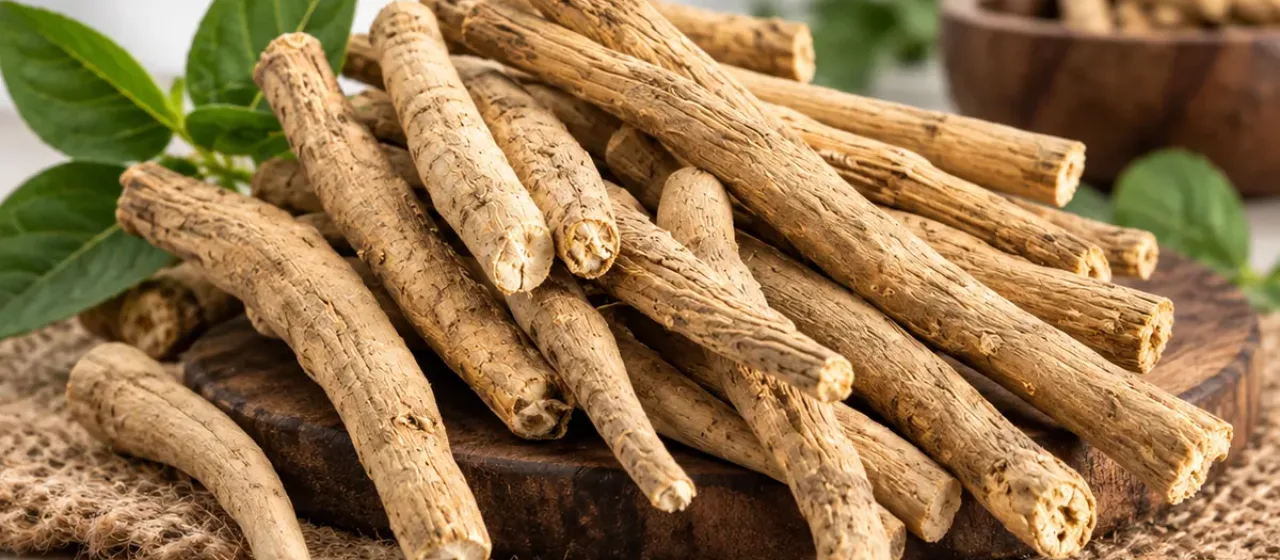
- Ashwagandha root powder is the dried root, cleaned and milled. Nothing is concentrated or removed. It is the simplest and lowest-cost form, and it is popular for powders, teas and traditional-style products. See our bulk ashwagandha powder (60 to 100 mesh).
- Ashwagandha extract is made by extracting the root with water or a water-alcohol mix and drying the result into a fine powder. It is offered either as a ratio extract (for example 10:1) or standardised to a percentage of withanolides. A smaller dose delivers more of the plant's marker compounds, which is why most capsule brands use it. See our ashwagandha extract.
- Ashwagandha capsules are a finished product: powder or extract filled into vegetarian (HPMC) or gelatin shells with a fixed dose per capsule, then bottled and labelled. See our private label ashwagandha capsules.
For a consumer-side view of dosage, side effects and who should avoid ashwagandha, read Ashwagandha Powder Capsules: Benefits, Dosage, Side Effects and How to Choose.
Which format should you buy? It depends on your business
Buy bulk powder or extract if you are a manufacturer
Contract manufacturers, supplement brands with their own encapsulation, and food and drink companies normally buy raw material. You control the dose, the blend (ashwagandha is often combined with magnesium, L-theanine or other botanicals) and the final format. Bulk material usually ships in 25 kg drums or bags, which keeps the cost per kilo down.
Buy finished capsules if you are a brand without a factory
Start-up brands, Amazon sellers and distributors often prefer a finished product. You choose the formula, the capsule type, the count per bottle and the label, and the manufacturer delivers ready-to-sell goods. The trade-off is less flexibility once production is booked, and a higher cost per kilo of active ingredient.
A simple rule: if you already own a capsule line or work with a co-packer, buy extract. If you want stock you can sell next month, buy finished private label capsules.
Ashwagandha root powder vs extract: which is better for capsules?
For capsules, most brands choose a standardised extract. A size 0 capsule holds roughly 400 to 500 mg of powder, depending on density. With plain root powder, two to three capsules may be needed to reach a typical serving. With a concentrated extract, one capsule is often enough. That keeps the bottle smaller and the label simpler.
Root powder still has its place: in loose powders, "whole herb" positioning and lower-cost products. Many buyers stock both, using extract for capsules and powder for blends.
What to check on an ashwagandha certificate of analysis (COA)
Whatever you buy, ask for a COA for every batch and read it before you pay the balance. These are the lines that matter most:
- Identity and plant part: root only, or root and leaf? They are not the same material, and some markets only accept root.
- Withanolide content and test method: the percentage means little without the method, usually HPLC or gravimetric. Results from different methods are not directly comparable.
- Extraction solvent: water, or water and ethanol. Your regulator or customer may have a preference.
- Heavy metals: lead, arsenic, cadmium and mercury, tested against the limits of your target market.
- Microbiology: total plate count, yeast and mould, and absence of E. coli and Salmonella.
- Pesticide residues: especially important for EU buyers, where limits are strict.
- Moisture, mesh size and shelf life: our ashwagandha materials carry a 24-month shelf life in original sealed packing.
How to import ashwagandha from India: step by step
- Check that you are allowed to sell it. Rules differ by country. Some countries restrict or review ashwagandha products, so confirm the position in your target market before you order.
- Send a clear specification. Include the form (powder or extract), the standardisation, the mesh size, the quantity, the packing and the destination country.
- Ask for samples and a COA. Test the sample in your own lab, or a third-party lab, if your market requires it.
- Agree the Incoterm. We usually quote on EXW, FOB, CIF or DAP terms. Small or urgent orders go by air or courier, larger orders by sea on pallets or in containers.
- Check the export documents. Expect a commercial invoice, packing list, COA and certificate of origin, plus safety data sheets or phytosanitary certificates where your importer needs them.
How much does bulk ashwagandha cost, and what is the minimum order?
Price depends mainly on the form (powder costs less than standardised extract), the withanolide level, the quantity and the packing. Minimum order quantities depend on the product and pack size. Finished capsules also depend on the bottle and label. The fastest way to get a firm number is to send your specification and target quantity for a quote.
Choosing an ashwagandha supplier
Look for a manufacturer who can show certificates for the facility as well as the product. Arizone International LLP manufactures and exports from Daman, India, under ISO 22000, GMP and HACCP, and ships to importers and brands in the USA, the UK, the EU, the Middle East, Australia and 40+ other countries. We supply export customers only.
Ashwagandha Sourcing Questions
Most capsule brands use a standardised extract, because a smaller amount delivers more of the marker compounds and fits into fewer capsules. Root powder is common in loose powders and lower-cost products.
It depends on your product and market. Always ask which test method was used, because HPLC and gravimetric results are not directly comparable.
Yes. You choose the formula, vegetarian or gelatin capsules, the bottle count and the label, and we manufacture, pack and ship the finished goods to your warehouse, distributor or an Amazon fulfilment centre.
Extract is usually packed in 25 kg fibre or HDPE drums with double food-grade liners, or in 1 kg and 5 kg foil bags. Root powder ships in 20 to 25 kg lined bags.
No. We supply export customers only, shipping to the USA, the UK, the EU, the Middle East, Australia and 40+ other countries.